
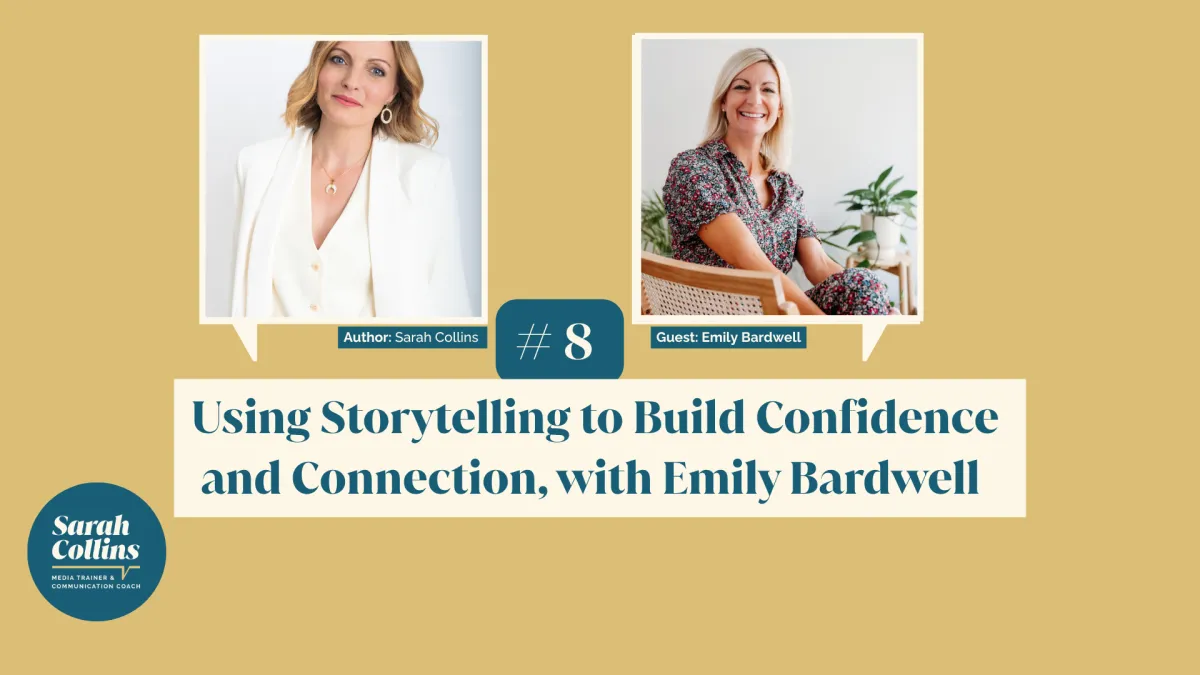
Using Storytelling to Build Confidence and Connection, with Emily Bardwell
Emily Bardwell is founder of Telling Tales Media, a social media strategist, and self-published children's author. Emily helps founders find and tell their stories in a way that feels genuinely true to them, with a clear strategy behind it. Her work sits at a fascinating intersection: two decades in marketing and communications, four years leading social media for a global consultancy, and the experience of publishing her own children's books - all of which, as you'll hear, have more in common than you might think.
Emily, can you share the moment you realised your voice truly mattered?
It's something I still struggle with a little even now - and it's something I see a lot of people needing support with all the time.
For me, the moment came a couple of years ago when I was publishing my first children's book. As a new author, the imposter syndrome was significant. Everything I was sharing on social media was about my book and my story - quite structured, quite polished. It was only when I started letting people in a little more, bringing them on the journey, and sharing my own experiences of being a new author, leaning into the vulnerability of that, that I suddenly saw a big shift in the response I was getting.
More engagement, more DMs, more questions from other authors who were really interested in my journey. And that sparked so much more interaction than the more informative content ever had. It was a real light bulb moment: there will always be someone further along than me. But at the same time, there will always be someone who wants to be at the point in the journey where I am and they're interested in how I got there. That was when I truly understood the power of story-led content.
Do you see those fears and doubts show up in the clients you work with?
All the time. So much of how people show up online comes down to confidence. People are so reluctant, worrying about what value they can add that hasn't been said before, or how to show up in a way that feels credible and professional without oversharing.
And I think showing up online is actually more daunting in some ways than showing up at a face-to-face event, because anything you put out online is there long-term, for everyone to see. That permanence adds an extra layer of pressure that I think holds a lot of people back.
You went on to lead a team in social media strategy for a global consultancy. Tell us a bit more about that journey.
I've worked in marketing and communications for around twenty years, across a huge range of industries, always looking for ways to turn heavy or complex information into something that would genuinely connect with an audience.
Four or five years ago, I stepped into a role leading social media for a global consultancy. What became obvious to me over those four years was that the content really landing was the content about people - their experiences, their stories. Whenever the CEO spoke, it always performed exceptionally well and this was right around the time employee advocacy was exploding as a concept.
We launched an employee advocacy programme, bringing around 200 senior leaders into it and working with them to build their LinkedIn presence. These were hugely knowledgeable, highly experienced people. But, put them on social media and they simply didn't know how to show up in a way that was credible, professional, and still authentically them. That was a real light bulb moment for me - I realised this was an area where I could genuinely help people.
At the same time, I was publishing my first children's book. And what became obvious was the overlap between children's storytelling and business content strategy - the framework, the structure, the things that make a story land. That's what led me to set up Telling Tales Media.
We share the philosophy that everyone has a story worth telling. What would you say to a founder who thinks theirs isn't worthy?
Absolutely everyone has a story worth telling and in the age of AI, this matters more than ever.
We've shifted from an era where polished and professional was the standard to one where authenticity is what actually builds trust. That's quite a hard adjustment for people who, like me, grew up in marketing being told that everything had to be perfect. But showing up as yourself requires a real vulnerability and I think it's often easier and safer to hide behind something polished, because it means not having to be as exposed.
I went to a conference recently with around a hundred other people who do a similar role to me. And I didn't walk away thinking: there are too many of us doing the same thing. I walked away thinking: we all have something completely different to bring. Different angles, different enthusiasms, different areas of expertise. Nobody was bringing the same thing. And that's what I always try to help my clients understand.
Also, this is important, you do not have to share your entire life online to tell your story. Storytelling isn't about oversharing. It's about helping people understand how you feel, and creating experiences they can connect with and relate to. It's the specific detail of a small moment that allows people to feel it with you. When you're generic, it could be anyone saying it. The detail is what makes it yours.
For someone new to storytelling, where do you suggest they start?
I always work with two types of stories - and you need both.
The first is your founder story: the big narrative that explains who you are, why you do what you do, who you're trying to help, and the experiences that shaped you. This is the story that builds deep trust and creates that moment of recognition in your audience - this person gets me. It's not something you repeat every week, but something you weave in at the right moments across your content, your website, your emails, your blog.
The second is your everyday micro stories: small moments from your week that you wouldn't necessarily think of as significant. I always recommend keeping a small notebook - one that fits in your bag - and jotting things down as they happen. A conversation with a client. Something that went brilliantly. Something that went wrong. A small moment of surprise or recognition. You might never use some of them. But when you come to create content, you'll have a bank of real moments to draw from and you can look at which ones align with your content themes and what you're trying to achieve.
Both types of story are important. If you only ever use your founder story, people miss out on the ongoing familiarity that builds day-to-day trust. If you only ever use micro stories, you lose the bigger narrative that helps you stand out.
What are your tips for people who want to show up more authentically online?
Say it how you'd have a conversation. Not how you think it should be said, or how you imagine people want to hear it, but in the natural, conversational way that actually sounds like you. People can tell, very clearly, when content has been written in someone's genuine voice. And that recognition is exactly what you're aiming for.
It also comes down to having confidence that what you've got to say is valuable - that there really are people who want to hear from you. I worked with a client recently who had a wonderful, slightly quirky personality, and she was nervous about whether it would be well received. She already had a good following - people were already there and engaged. I said to her: they don't have to be here. They're choosing to follow you. So give yourself permission to be who you actually are, because they're already listening.
The shift I saw in how she then started to show up was wonderful. She was having fun with it. And you can always tell when someone is enjoying what they're doing - just as you can tell when it's a slog. It takes practice. It doesn't happen overnight. But the more you do it, the more comfortable it becomes.
What are your thoughts on AI and storytelling?
We're definitely becoming more savvy at recognising AI-generated copy and that's exactly where storytelling becomes even more essential. No matter how well you train it, AI doesn't know your experiences. It can't ask you about the moments it doesn't know about. It can't bring in the specific details that make your story yours.
AI has its place - I use it for processes, for sense-checking ideas, for anything that genuinely speeds things up. But writing social media copy in your own voice? That has to come from you. Because if it doesn't, it all starts to sound the same. And in a world where trust is everything, generic is the thing you can least afford to be.
You're also a self-published children's author. What are the parallels between children's storytelling and business content?
Let me start with a small story on that.
My first children's book is about a little crocodile called Ellie who is nervous to try a gymnastics class. Throughout the story, she repeats a mantra: I think I can, I think I can. It's all about building her confidence and at the end, spoiler, she does the class and loves it.
A few weeks after it was published, I got an email from a dad who said his daughter had been in the playground, nervous to try the monkey bars. He heard her say to herself: I think I can, I think I can. And she made it to the end. I did have a little cry.
But it made me ask: what is it that makes a story like that actually land with someone you've never met? And that question has a lot of parallels with business content.
Knowing your audience deeply - not just who they are, but how they think and what they truly need - is everything. When I sent my first draft to my editor, she came back and said: children don't think like this. We need to cut a lot of this out. We adults approach things in a certain process. Five-year-olds don't. That feedback made me a much better writer and it's the same principle in content strategy.
Creating characters your audience can relate to also matters. In business terms, that means putting your audience in the role of the hero, and positioning yourself as the guide who supports them. Clear, simple messaging. Ruthless editing. And repetition, because the worry that you're going to bore people by repeating your message is one I hear constantly. But your followers aren't seeing everything you post. Repeating your core message, in different formats and at different moments, is how it eventually lands.
For someone with a speaking opportunity coming up - where would you suggest they start with storytelling?
Stories can be woven into almost anything - any conversation where you want to share something of yourself, offer an experience, or create a moment of connection. A story leaves people with something memorable. It gives them something to engage with, something that might trigger a response or spark something in them.
If it's a podcast, it might prompt a listener to get in touch. If it's a talk, it might be the one thing the audience remembers. A story is what creates that moment of I felt that too - and that's what makes you memorable long after the speaking opportunity is over.
To close, can you fill in the blank: listeners should speak with...
The courage to sound like themselves. I think it takes quite a lot of courage to be yourself, to let people in and allow them to see the real you. But I genuinely believe people want to hear from you and it's very common to assume that others already know what you know, so why bother sharing it? But when you start to break down those barriers and let people in, you realise there are a lot of people who are really interested in what you have to say. Having the courage to let that out - to allow yourself to connect with the right people - has so many benefits. So speak with the courage to sound like yourself.
Emily can be found @tellingtalesmedia on Instagram, and on LinkedIn at Emily Bardwell. She'd love to hear from you - drop her a DM.
Prefer Audio?
You can also listen to this episode on my podcast: She Speaks to Scale.
Need a confidence boost before appearing on camera?
Download my free 5 minute camera confidence audio here

How To Work With Me
I'm Sarah Collins - Media trainer, Communication Coach, and former Senior Television Producer for ITV & ITN. I work with ambitious founders and spokespeople in businesses to help them communicate with clarity, confidence, and composure in the moments that matter most. If you've got a podcast, interview, or speaking opportunity coming up and you want to feel truly ready for it, this is how we can work together:
Founders who want to become an expert voice in their field
Organisations who want their representatives to become credible spokespeople