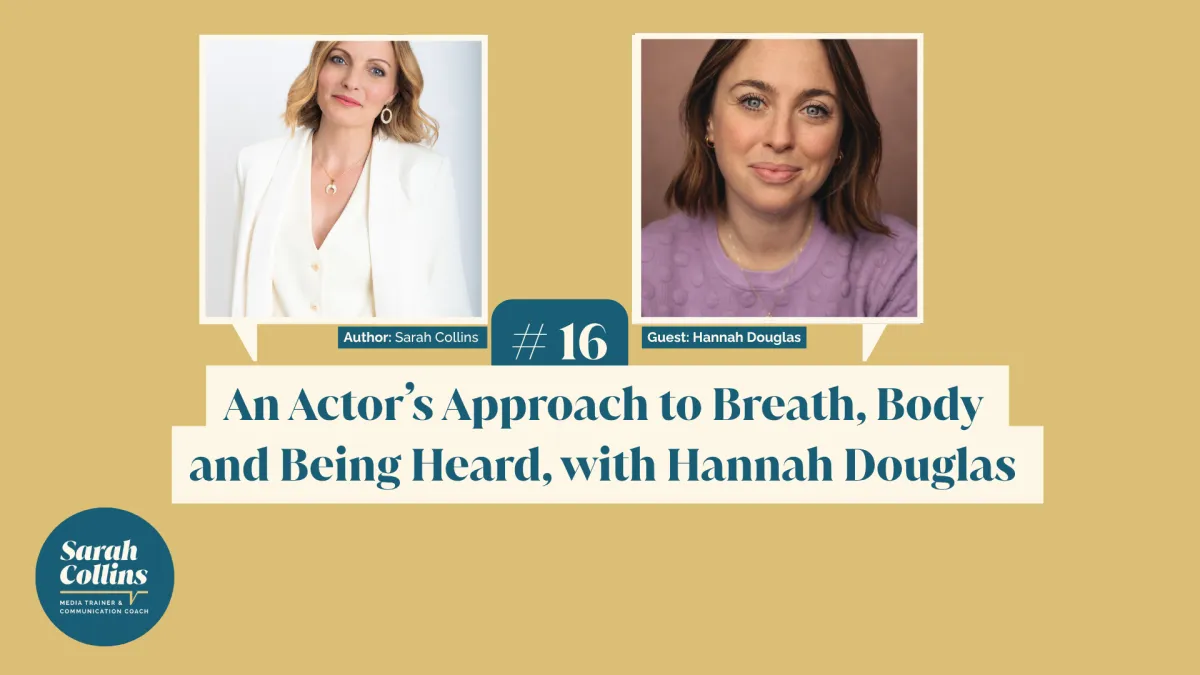
An Actor’s Approach to Breath, Body and Being Heard, with Hannah Douglas
Hannah is an Award-Winning Actress & Founder of LoudHer Voice Coaching. Her work spans British independent film, international TV dramas and theatre. Alongside acting, Hannah founded LoudHer, offering public speaking and voice coaching for women and teams. LoudHer brings actor-based tools into the workplace - helping women feel grounded under pressure, speak with clarity and confidence, and rediscover the power of their voice.
Can you share the moment when you realised your voice truly mattered?
Interestingly, even though I went to drama school and have been an actor for a long time, I actually think the moment I truly realised my voice mattered was when I had my little boy and became a mum. I suddenly understood that my voice mattered enormously in terms of how I speak to him, how I raise him, and how I choose to speak about myself around him.
Before that, even though I'd always been an actor, I didn't love speaking as myself. I liked being a character. But when I had Leo, I realised I wanted him to see me speak with confidence - as myself - so that he could see that my voice matters, and that women's voices matter too. That was really the moment.
You've always loved performing, but what was it about becoming other characters that drew you in so much?
When I was a kid, I think I was a lot more confident and I don't really remember a specific decision to go into acting. It just always seemed to be there. I came out of the womb dancing, unfortunately for my mum.
There was a big age gap between my sister and I - twelve years - so I had a lot of time on my own when I was young. My friend Holly and I would make up radio shows and become all the characters. There was something really joyful in giving each character a different voice.
But some of it was also about hiding. When I visited my Nana in Manchester and played with the kids there, I hated being called posh for my London accent. So I'd just put on a Manchester accent. Other people's voices seemed far more interesting than my own. So I'd imitate them - and in doing so, become someone else.
You went to drama school - what was that experience like, and how did it shape the voice work you do today?
I studied at drama school for three years and had a great time. We did all these mad, wonderful voice and movement exercises and I now realise it was all about figuring out and stripping away your own habits, where you hold tension, so that you could then become a character more freely. If you were a fly on the wall in a drama school, it looks completely bonkers. I think I spent an entire month in animal studies being a Komodo dragon, which is quite hard - it's essentially a permanent press up. So there were definitely moments of thinking: what am I doing?
But those exercises were so helpful. And it's fascinating when you look into why you have the fears you do about speaking, why your voice struggles, or why you feel like you run out of breath in certain situations - that's where it all started for me.
When I left, I did a lot of theatre- touring all over the UK and internationally, everything from Shakespeare to new writing, comedy, darker pieces, family shows. And then I slowly got more into film and television, which led me to Lapwing.
It’s a beautifully, brutal film set in the 1500s, about a woman born with a stammer at a time when that simply wasn't accepted. She was selective mute, so she held a quiet but significant power even without words.
We filmed the entire feature in around 16 days, which was incredibly intense. At the start, I decided not to speak for three days to feel what it was like to be unable to use your voice as you would want to. What struck me immediately was how other people changed - some started speaking for me, some became tentative around me, some stopped asking me things at all.
But what I really discovered was the power of silence. We are all so frightened of pauses. We rush to fill them. Leaning into silence - feeling the power it gives you - was genuinely revelatory.
Your character couldn't use her voice, so how did you portray her through your body and non-verbal communication alone?
That was the fascinating challenge. At the start of filming, when we were getting to know the co-stars behind the scenes, we were using a board - I was writing things down to communicate. But after a while you realise how much easier it becomes to just take a step back. It was really hard trying to communicate with people, and what was so interesting was watching how other people changed towards me as a result. Some started speaking for me, some became tentative, almost a bit uncertain around me because they knew I wasn't speaking, some stopped asking me things altogether.
Everything had to come through the body - eye contact, whether I was looking away or looking directly at someone, stillness, how I held myself physically. My co-star Emmett commented on certain scenes we filmed, saying it felt quite unnerving and unsettling, that it threw him a little. Because I often just used the power of presence and eye contact without saying a word.
What I really got from the experience was an understanding of just how much we communicate before we've opened our mouths. The body is constantly saying something. And actually, when you take the voice away entirely, you realise how much power there is in what's left - the stillness, the gaze, the breath. It was quite freeing, in the end.
There's a myth that actors are always confident. Is that true?
It's such a myth. Actors are often some of the least confident people, because so much of acting is about hiding behind a character. I loved portraying other people. I didn't really want to be me.
At school, I was an enthusiastic, performing-obsessed kid. And I started being given labels - too much, too confident, full of herself. That was horrendous to me, so I shrunk myself to fit in.
I think those labels are given more often to girls than to boys. And I don't think I really found my confidence speaking as myself - in front of groups of people - until I became a mum. It was motherhood that gave me a clearer sense of who I was and the realisation that I don't have to apologise for who I am or for speaking a certain way.
You talk about the connection between the voice and the body. What do you mean by that?
When we experience any form of trauma, whether that's something significant, or something as seemingly small as being given a label at school, we often unconsciously shut ourselves off from breathing fully. We get used to breathing shallowly, up in the chest, losing the full support system that deep breathing provides.
And if we're not breathing fully, that affects our voice. It affects volume, clarity, and confidence. How are you supposed to stand in front of people and speak with presence if your breath isn't supporting you?
Things that happen to us in life sit in our bodies. Where you hold tension, how you breathe - these are often signs of experiences you've carried. The voice work I do with clients starts from exactly this place.
What inspired you to start Loud Her?
When I became a mum, I met so many incredible women who felt unheard - not just at work, but in life. Women who felt like they were apologising for themselves constantly, or who didn't feel like they were using their voice in the way they wanted to. Especially those returning to work after a career break - it can feel really daunting, like you've lost your voice entirely.
I wanted to use my actor training and the voice and movement work from drama school - exercises that at the time seemed quite mad, but that I now understand were about stripping away tension and habit so that you could speak more freely. I wanted to bring those tools to women in the workplace.
I also wanted to challenge the idea that confident speaking is just about power poses and owning the room. Confidence isn't a personality trait. It's something that can be nurtured and built and everything, for me, comes back to the breath.
What would your top tips be for anyone starting out as a speaker?
I think about confidence as resting on three things: breath, permission, and choice.
Breath comes first. Taking a deep breath signals to your body that you are safe. It gives your voice the physical support it needs. And it creates a moment of mental clarity before you speak.
Permission is about asking yourself: do I feel safe enough in this moment to say what I really want to say? And how can I give that permission to myself, rather than waiting for it to come from someone else?
Choice follows. Once you have the breath and the permission, you can choose your words. Because often when we don't take a breath, we rush and things come out that we didn't intend. When we slow down, we can choose what we want to say, and stop at the end of a sentence without feeling the need to backtrack or apologise.
What practical techniques do you recommend before a speaking opportunity?
Two things that I always come back to.
The first is balloon breathing. Plant your feet firmly on the floor - shoes off if you can. Put your hands on your ribcage and breathe in through your nose, imagining a balloon expanding in your torso rather than in your chest. Then blow everything out on a sound, really squeezing the air out. Three to five of these before you speak will calm your body, signal that you're safe, and bring you into the present moment.
The second is humming. Actors do this all the time - humming a little tune, doing pitch glides up and down, or simply going mmm, mmm. You're warming up your voice, but humming also stimulates the vagus nerve, which tells your body that you're safe. It's simple, quick, and remarkably effective.
Between those two things - breathing and humming - you'll feel noticeably more grounded and ready to speak.
Women apologising for their voice comes up a lot. What's your take on that?
I agree completely that it's something women do far more than men and there's a clear historical reason for it. It's not that long ago that women got the vote. We haven't been encouraged to use our voices confidently. And when we do, we're often given labels - bossy, mouthy, loud, overconfident - that men simply don't get in the same way.
So no wonder so many of us feel we have to apologise when we express a view.
What I always say is: notice it first. Be curious rather than judgmental with yourself. There's a clear reason you do it - it's not a flaw. And then start making small changes. Take a breath before you start your sentence instead of saying sorry, I just wanted to. Stop at the end of what you're saying and allow the silence to land, rather than rushing to fill it or backtrack. It's a habit. And like every habit, it changes with time.
To close, can you fill in the blank: listeners should speak with...
The breath - everything comes back to the breath. There is no situation - a presentation, an interview, a difficult conversation, an argument, even dealing with a toddler - where getting back in touch with your breath and giving yourself a moment doesn't help. Take it right back to basics.
Speak with the breath.
Hannah can be found on Instagram at @LoudHerVoiceCoaching and at loudhervoicecoaching.com. You can also find her acting work on Instagram at @HannahDouglas.
Prefer Audio?
You can also listen to this episode on my podcast: She Speaks to Scale.
Need a confidence boost before appearing on camera?
Download my free 5 minute camera confidence audio here
When you’re ready, here’s how I can support you:
I'm Sarah Collins - Media trainer, Communication Coach, and former Senior Television Producer for ITV & ITN. I work with ambitious founders and spokespeople within organisations to help them become the confident, trusted voice their audience remembers - on camera and in every interview. If you've got a podcast, interview, or speaking opportunity coming up and you want to feel truly ready for it, this is how we can work together:
Founders who want to become an expert voice in their field
Organisations who want their representatives to become credible spokespeople