
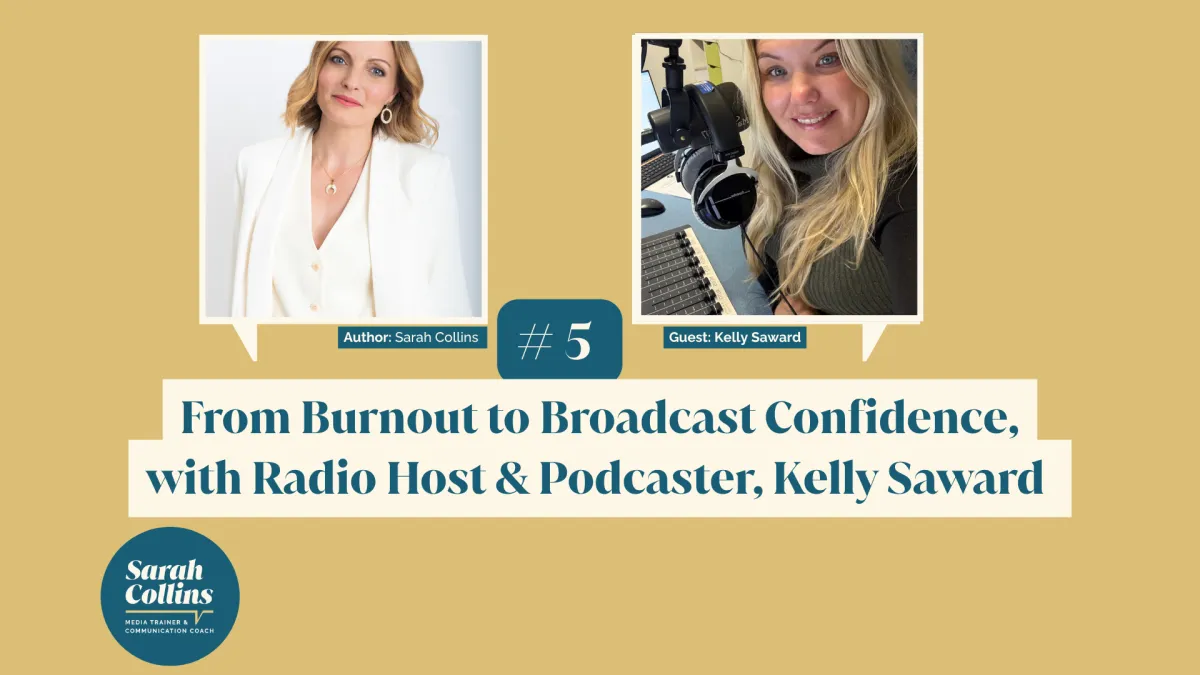
From Burnout to Broadcast Confidence, with Radio Host and Podcaster Kelly Saward
Kelly Saward is a UK-based wellbeing specialist, broadcaster, and founder of Room 478. Kelly creates supportive spaces where people can be truly heard, helping individuals and organisations build confidence, resilience, and emotional wellbeing through mindfulness and conversation. She is also the author of Desperate to Be Loved, and hosts her own radio show and podcast, Can You Hear Me?
In this conversation, we talk about the power of self-belief, interviewing from a place of intuition, and how to stay grounded when the pressure is on - as well as Kelly's own deeply personal journey to finding and trusting her voice.
Can you share the moment you realised your voice truly mattered?
I think, if I'm honest, it was the point where I was almost just tired of trying to say the same thing in a multitude of ways - when something important to you isn't landing, no matter how many different ways you try to express it.
I remember very clearly being in a space, sharing something that mattered to me, with people I didn't even know. And a woman said: that's really interesting, because I feel that way. And I thought, okay. What I have to say isn't just sounds. It does matter. It's just about the environment and people's life circumstances.
I think it's relatable content, isn't it? When someone can truly relate to what you're saying, it strengthens the belief within yourself. That was the moment I stopped falling into dead air space on repeat.
Anxiety was present for a big part of your life. Do you think that's part of why you didn't feel heard?
Growing up, there were quite conflicting times with mental health in my family and it was never shared or discussed. There was a lot of silence, shame, and no real conversations around what was happening, which I found really difficult.
I appeared to function reasonably well on the outside, maybe a bit of a challenging teen. But when I got older and had my own children, the anxiety really took hold. My way of coping became a kind of health obsession - anything health-related, I would fixate on. And even now, if I'm going through a particularly difficult time, I notice that pattern coming back. It's the loop. But people outwardly never really saw it, because I'm quite smiley and often look happy. Underneath, yeah, it was all-consuming. It was awful.
How did that internal experience present itself when it came to using your voice?
I was embarrassed for a long period. That shame loop came back around. I didn't want to share what I was truly feeling because I was worried about how it would be interpreted.
I've always been a talker in some ways, I've always shared my voice. But not the true one. Not the one that really mattered. And I think that's the same for a lot of us. We can show up in situations, say things to fit in, present ourselves in a particular way. But is that really what's coming from deep inside? Often not.
I did a lot of people-pleasing with my voice. I'd say what I thought fitted the environment. It was quite scary, eventually, to start using my real voice.
Was there a defining moment when you decided to step out from behind the mask?
I reached breaking point. I've always written - my whole life, writing has been how I hear my own voice. It's a safe space to listen to what I have to say.
At this particular low point, I couldn't cope in the way I usually could. I'd already attended a couple of eight-week mindfulness courses, so I went back for a third. I'd tried meditation before and thought it was a waste of time - I was busy, I had kids, life was full. But this time, I thought: I've really got to do something now.
I started meditating again. Slowly, over months, alongside the writing, things began to shift. The changes weren't dramatic or instant and that's actually the key thing about mindfulness and meditation. People expect it to bring things to them, but it does the reverse. It takes the noise, the anxiety, and the stress away.
I went on to train as a mindfulness teacher, and started holding groups. Those groups are no different, really, from the conversations I now have on radio. I just want people to be truly heard for what's inside, safely. That was the turning point. And then I was interviewed about my book and my work, and people said - you're good at this, you should do more of it. And I thought: I'm actually going to believe in myself for a change. It snowballed from there.
What would your top tips be for someone who is lacking self-belief and wants to be heard?
I think we need to welcome the lack of self-belief, rather than push it away. We're pushing things away constantly, and it just creates resistance. So anything I struggle with now, I sit with it. I ask: why am I doubting this? What is it? What part of me is speaking right now?
If you're lacking in self-belief, let yourself feel it. Don't just let it linger unacknowledged. We need to look at it to see what the self-doubt is actually trying to tell us. Because self-doubt is like anger: it's always a secondary emotion. There's something underneath it. And unless we look at what that is, we can't move through it.
So my advice is simply: let it in.
People might look at you - a broadcaster, a radio host, a podcast presenter - and assume you have an abundance of self-belief. What would you say to that?
It's not true. It really isn't. I do believe in myself a lot more now, and I've reached a point where I feel genuinely confident in certain situations. But it's not confidence for its own sake - it comes from the passion I have for what these conversations create. I can't not do it. It's gone beyond the job itself. I want someone to be able to say what's inside, so that others feel safe enough to do the same.
The confidence comes from making a difference. It's taken over the doubt - not replaced it. The doubt is still there, but the scales are balancing. The voice that believes is just a little louder than the one that doesn't. And I run with that.
You create space for honest conversations and diverse voices to be heard. Why is that so important to you?
Because I don't feel I had it. It's that simple.
I spent a lot of time trying to get my point across, only to be told I was too much. That it wasn't the right time. Could I be quieter? And actually, no. If something is really important, you wouldn't try to say it in 55,000 different ways if it didn't matter.
I think more and more people need to be holding spaces for others to be heard, so that connections can form. I say to my children: whatever the thing is, there's no shame in sharing it here, it's okay, we've got it. Because when difficult things stay trapped inside, they go into the body. Dis-ease is essentially when we're not at ease with who we are or what we're facing. The difficulty isn't always the challenge itself - it's the not being able to feel or express it. That's the truly hard part.
You interview guests from a place of intuition rather than a pre-prepared list. How do your guests find that?
I've had a little resistance, honestly. I remember a guest early on who brought me a long printed list of everything she wanted to cover. She'd emailed it to me beforehand and I hadn't read it, on purpose. When she arrived with the list, I told her: I haven't read it, because it's really important that I go from what my heart says here. But we'll check in halfway through, and if there's anything we haven't covered, we'll absolutely get to it.
We covered everything without looking at the list.
It's similar to a meditation group, actually. When people come and sit in that circle, my intention before we even begin is for people to feel safe. It's the same in the radio studio. When someone comes through that door, I want them to feel safe first. From there, the conversation follows.
What makes a good guest, in your experience?
Anyone who is open. Anyone who can trust themselves - and me - to the best they can, and just be present. That's it. Because everyone has a story.
I once interviewed someone's husband who had just opened an IT business. My radio show is called The Nature Nurture Show - it's all about wellbeing. He wanted to talk about his business. And his story came back to the same place they always do: how he'd struggled, as a man, to feel like he could support his family while setting up something new. There is so much in everyone, if they feel safe enough to share it.
Making people feel safe enough to share something real - I think that's become my skill. And it's all I really want.
How do you ground yourself ahead of your radio show? Do you have any rituals or strategies?
I meditate regularly, though not at a fixed time - I pause when I feel I need to. On my radio show, at 11.11 every week, I do a mindful minute.
For anyone who wants a practical technique - whether to prepare for a speaking opportunity or to manage a moment of panic - I'd recommend 5-4-3-2-1. It taps into your senses:
Five things you can see
Four things you can hear
Three things you can touch
Two things you can smell
One thing you can taste.
You're immediately present. It's brilliant in a panic attack, but it works just as well before any high-stakes moment. That sensation of really just being here, now - it changes everything.
What's one myth you'd love to dispel about what you do?
That people who do this kind of work have it all together. That we don't feel fear or doubt.
I don't go through a single day without doubting myself at least once, even if it's tiny. I've just finished writing my second book and thought: is this rubbish? Should I actually do this? I question myself at the end of every radio show - did I ask enough? Did I miss something?
The myth is that we're aiming for a space where those feelings are completely gone. I don't think we ever get there. And I don't think that's the goal. The goal is just for the voice that believes to be a little louder than the one that doesn't. That's all.
To close - can you fill in the blank: listeners should speak with...
……love. I feel everything comes back to love. I lead from the heart - it's who I am. So speak with love. And most importantly, speak with love to yourself, because we give ourselves such a hard time. We would never speak to our friends and family the way we sometimes speak to ourselves.
Kelly can be found on Marlowe FM, usually on Tuesdays or Wednesdays between 10 and 12 on Good Morning Marlowe. Her podcast Can You Hear Me? is available on Spotify, Apple, and all major platforms. You can find her broadcasting work at kellysaward.com and her wellbeing work, including her book Desperate to Be Loved, at Room478.com.
Prefer Audio?
You can also listen to this episode on my podcast: She Speaks to Scale.
Need a confidence boost before appearing on camera?
Download my free 5 minute camera confidence audio here
How To Work With Me
I'm Sarah Collins - Media trainer, Communication Coach, and former Senior Television Producer for ITV & ITN. I work with ambitious founders and spokespeople in businesses to help them communicate with clarity, confidence, and composure in the moments that matter most. If you've got a podcast, interview, or speaking opportunity coming up and you want to feel truly ready for it, this is how we can work together:
Founders who want to become an expert voice in their field
Organisations who want their representatives to become credible spokespeople