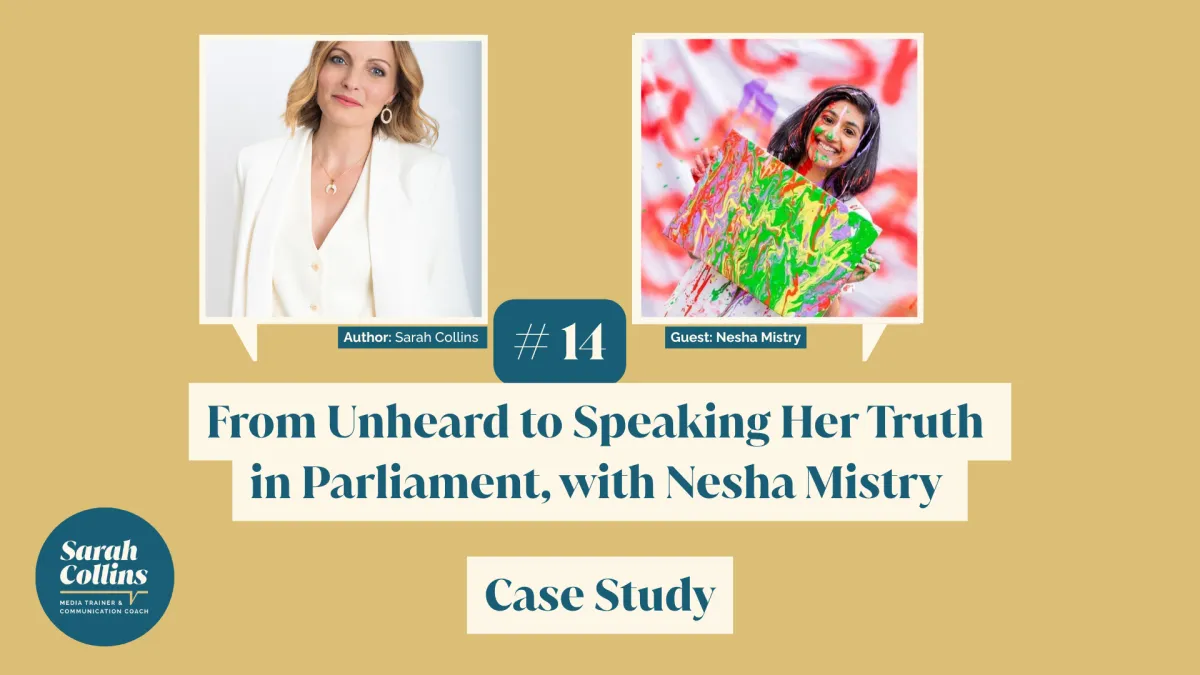
From Unheard to Speaking Her Truth in Parliament, with Nesha Mistry
Nesha Mistry is a self-taught Artist, Emotional Wellness Mentor and Founder of Nesha Canvas Creations. She facilitates workshops and community experiences designed to support people of all ages, backgrounds and abilities in reconnecting with creativity, joy, and a sense of belonging.
Can you share the moment when you realised your voice truly mattered?
There's a really vivid memory that came to me when I was reflecting on this question. I was eleven, year six, sitting at lunch. Some of my peers were vegetarian, I was eating a chicken sandwich my mum had made. Someone made a comment that didn't sit well with me - something about it being wrong to eat meat.
And I don't know why, but something in me just spoke. I said: I respect that you're vegetarian. Please respect that I eat meat. And if you don't like it, maybe we sit at different tables.
A boy at the table started clapping. And I remember thinking - maybe what I'm saying resonates. Maybe I'm being the voice for someone who was thinking it but hadn't said it out loud. I was less filtered back then. But that was the moment I first understood what it felt like to speak and be heard.
You said your voice was either too loud or too small growing up and eventually you stopped sharing much at all. Can you explain a bit more about that?
When you're young and unfiltered, you just share. Random bursts of song, curiosity, wanting to connect. But family dynamics, the need to be proper, the conditioning of stay quiet - it slowly mutes something in you.
I never really knew how much or how little to share, or where it was safe to do so. Who can I trust with my inner world? And so I became cautious everywhere. The volume would go up when I was joyful, and completely mute when I felt out of alignment — or high-pitched and performative when I was trying to be something I wasn't. I never found the balance until much more recently. I know now that I'm more central, but it took a long time to get there.
What you do now - creating safe spaces through creativity - how does that connect to everything you went through?
It comes from being the thing I needed and never had.
Through my own experience of being shut down, unheard, unseen, invalidated - I now show up for other people with what I'd describe as a pitchfork going: ‘it's okay. Here is a space where you can speak, share, cry and it will be welcomed, not shunned.’ There's even a rule in my spaces: if someone is judging or shaming another person, they'll be asked to leave.
The creative element matters too - because connection doesn't always start with words. People come in, work with their hands and feel calm and grounded. And then the conversation comes naturally, from a place of safety. I've had people - children and adults alike - just burst into song in the middle of a workshop. No music on. Just their inner child coming out. And that is welcomed, that is the whole point.
Why do you think adults lose that creative freedom and in turn, freedom to use their voice, as they get older?
I think we're told what the right things are to do from a very early age and we're not given the freedom to explore, to decide, to just be. I have nieces and nephews who are eleven and twelve and already feeling anxious and depressed because of the pressure of the next exam, the next step, university at twelve. Can we just remember that they are children?
Societal expectations are damaging in ways we don't fully acknowledge. The arts - theatre, dance, play, sport - give us the strength to figure out the next bit. They balance us. We're too left-brained. Too focused on the logical, the linear, the next step. And all of that creates anxiety instead of presence. When we're present, the next step feels doable.
Did you feel that art gave you a voice, when you didn’t have one?
Art never spoke back to me. I created, and it was there and it loved me, because I made it. I didn't have to say anything. It just let me breathe.
Growing up - overwhelmed, anxious, bullied, experiencing suicidal thoughts, not feeling worthy - art was the one place I felt safe. I made something, it was mine, and no one could take that away from me. It's the same principle as your voice: ‘I really like me. I'm mine. You can have an opinion, but that doesn't make it true.’
Creativity is an outward practice for processing what's inward. And once things start making sense on paper or on canvas, the words come. The speaking comes. It helped me rewire, to build self-compassion, to start being kind to myself, so that I could eventually begin to express to other people and feel comfortable doing it.
As a client of mine, we worked together for a period of three months. Can you talk about that journey and what you do differently now as a result?
My messaging was a mess. I didn't have a proper title. I was everywhere. And you helped me feel seen - you actually understood what my mission was, and that made it start to make sense. It was like a snake shedding its skin. Each session, another layer would fall away and something newer, shinier would emerge.
One thing I loved about your coaching was how you helped me understand where the fear was coming from - how to navigate it, and how to make friends with it. The passengers on the bus exercise will always stay with me.
And believe me, Sarah, when I'm out there speaking, you're in the back of my mind - the cheerleader.
I don't think the year six version of me would believe where I am now. But I'm really proud of myself. And I wouldn't have got here without the support I had - you being a huge part of that.
One exercise I introduced to you, had a profound effect - the passengers on the bus exercise. Tell us a little more about that.
I loved it because it was visual and you got to know me well enough to know that's how I work.
You gave me a picture of two buses - big American yellow buses for some reason. On the first one - the old, rusty, fading yellow one - I wrote down all the old beliefs. You're not worthy. Your voice doesn't matter. Why are you here? Heavy, unhelpful passengers I'd been driving around for far too long without realising how much weight I was carrying.
On the second bus - new, bright, full of energy - went the beliefs I was building. Self-confidence. Worthiness. I can do this. My sister and I talked about it afterwards and she said she pictured little potato chips with stick arms going ‘yippee.’ And that image just stuck and Sarah, you're on that bus too.
It made me realise how heavy the old bus had been. And it's not always easy to stay on the new one - I still have setbacks. But the new bus is getting stronger. And the tools are always there when I need them.
You mentioned setbacks, which is something people don't always talk about. What works for you in those moments?
I take a pause.
I've had moments where I've wanted to quit, chuck all my materials in the bin, walk away from everything, but I've learned that every time I've had a real setback, there's been a reminder somewhere that this is my journey.
One time I told my sister I was done. I was ready to quit. A few hours later, I got a message on Instagram from someone who'd seen my work and wanted to collaborate. Just like that - those little reminders are hope, they give you the confidence to get back up.
Now, a setback means: take a pause. Go for a walk. Look inward. Be present in it. And tell myself - ‘today I'm not doing anything with my business, and that is okay.’
Our bodies are always talking to us. I get jaw pain when I'm not expressing my truth. Lower back pain, gut pain - that's misalignment. Your body is signalling that something is off balance. Please don't ignore those signs. I did when I was younger and it catches up with you.
To close - can you fill in the blank: listeners should speak with…
Truth. Speak with truth - to yourself first, and then to others.
And when I say truth, I mean: what is in alignment with you? What do you love? What do you need? What are your wants? All of those things are authentically you. That is who you are beneath the societal conditioning, beneath the adulthood coating, beneath everything that's been layered on top.
Start there. Speak your truth to yourself first and then you can be truthful to others.
💙 This episode touches on suicidal thoughts. If anything in this post or the episode resonated with you personally, please know that support is available. You can contact the Samaritans any time on 116 123 or visit samaritans.org
Prefer Audio?
You can also listen to this episode on my podcast: She Speaks to Scale.
Need a confidence boost before appearing on camera?
Download my free 5 minute camera confidence audio here
When you’re ready, here’s how I can support you:
I'm Sarah Collins - Media trainer, Communication Coach, and former Senior Television Producer for ITV & ITN. I work with ambitious founders and spokespeople within organisations to help them become the confident, trusted voice their audience remembers - on camera and in every interview. If you've got a podcast, interview, or speaking opportunity coming up and you want to feel truly ready for it, this is how we can work together:
Founders who want to become an expert voice in their field
Organisations who want their representatives to become credible spokespeople