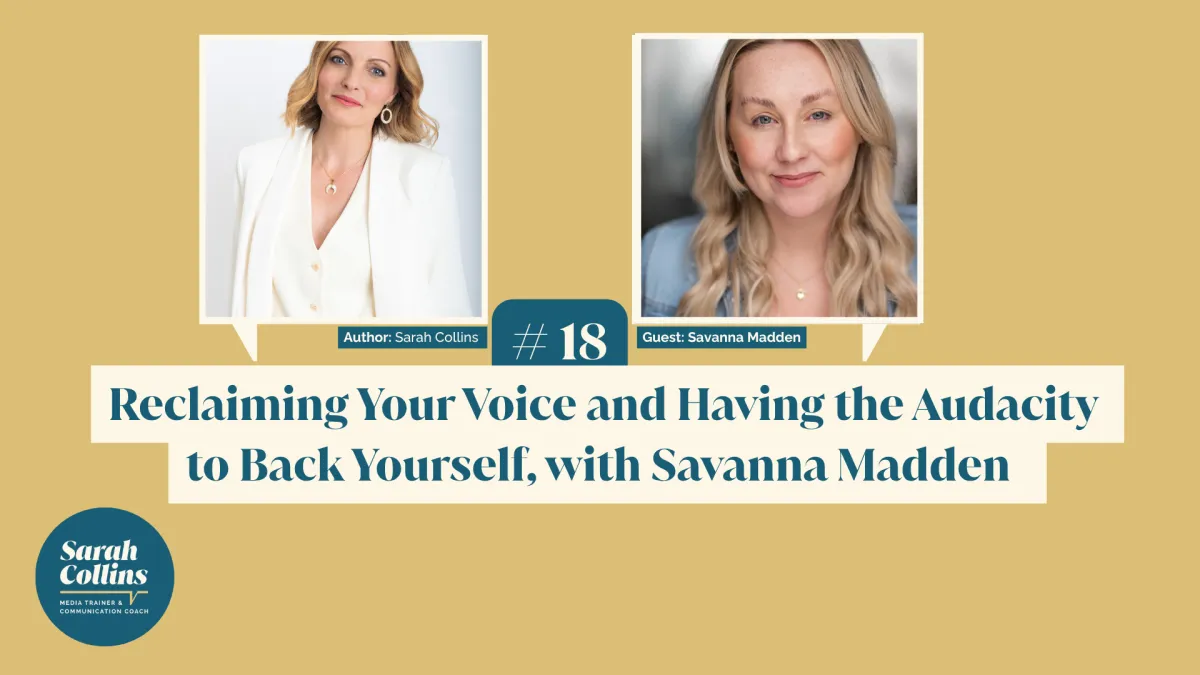
Reclaiming Your Voice and Having the Audacity to Back Yourself, with Savanna Madden
Savanna Madden is a Confidence and Speaking Coach for Female Founders, Founder of Award-Winning Madden Theatre Arts, and host of the Reclaim Your Voice podcast.
Drawing on decades of performance training, vocal work, and somatic techniques, Savanna helps women build the confidence to speak on stages and podcasts so they become known for their expertise and attract the clients they want.
Can you share the moment when you realised your voice truly mattered?
I actually lost my voice - literally - over ten years ago. I was diagnosed with vocal nodules and I was from a performing arts background, still working as a performer at the time, so it was pretty catastrophic. Losing your voice, no matter what industry you work in, would not be ideal - but for me, it was everything.
I was very lucky that I had access to speech therapy through the NHS - a wonderful speech therapist who I worked with and I also sought out alternative therapies including reiki. I was able to recover without surgery. I was told the nodules were from overuse and stress, and I later found out it was also a trauma response.
But you don't realise what you've lost until you've lost it. Once my voice started coming back to full strength, it was the catalyst that made me start my first business. I thought - I'm going to use my voice for good, I'm going to inspire and coach young people to use their voices, give them a platform. That was the real turning point.
When you were going through that - losing your voice at a time when so much else was falling apart - what kept you going?
At that time, I had just left a nearly ten year relationship, I was getting divorced, I was thousands of pounds in debt, and living in a shared house with people I didn't know to save money. The stress of thinking I can't do my job and I can't earn money was multiplied by everything else going on in my personal life.
But I always thought, this just can't be it, there will be a way out. I'm a glass half full sort of person, and I was really lucky to have an incredible support network. My parents are amazing, I had wonderful friends and I just knew there would be something on the other side.
The speech therapy gave me not just exercises but actual tools to regain my voice. I used a head mic to teach with so I didn't have to project - using my voice as softly as possible while it recovered. Every time my voice got a little stronger, I hit another milestone. Those small steps gave me the proof that something was working and that's what helps you grow in confidence. One step forward, then the next.
What was your relationship with your voice like growing up?
It's really interesting - until the age of ten, my grandmother lived with us, and she was deaf. She was made deaf at birth. My mum grew up in a household with two deaf parents, so she's quite softly spoken, and we didn't live in a house where you'd shout from downstairs to upstairs - you'd always go and find the person you wanted to speak to.
My grandmother lip read - she didn't sign - so we did a lot of communicating without our voices. I could lip read her, she could lip read me. It was a very vibrant household in so many ways - my mum and dad are real hosts, always throwing parties and fundraising events - but quite a quiet one at the same time.
What I really got from growing up around my grandmother was an understanding of how much we communicate physically, not just verbally. Body language, facial expressions, presence - you can tell so much without a single word. She was also a dancer, and that's how I started in performing arts - in dance. She used to feel the music through vibrations, which is just so fascinating.
Losing her when I was only ten was really tough, but she had an enormous impact on the way I see communication, inclusivity, and the voice.
You went into performing arts training - what was that experience like?
My experience on the whole was pretty positive, but I definitely felt vocal issues arise during training - this was way before I was diagnosed with nodules. I'd had laryngitis, tonsillitis, and glandular fever as a teenager, and I felt those things lurking a little in my early twenties.
I also felt like some of the singing training I received was quite flamboyant in its approach. It wasn't until I was trained in a different technique later on, one that talked literally about how your larynx works and how your vocal folds vibrate, that things really clicked for me.
On a personal level, I was quite often labelled in my year, as the organised, together, motherly figure. And I just didn't want that label. I was also, I now realise, doing a lot of masking. I feel like I have a lot of markers for ADHD, and I think a lot of my training kept the more spontaneous, chaotic parts of me really contained. Looking back, if I'd let go of that more, I'd probably have been even more successful in my performing career.
You mentioned your marriage - how did that affect your voice?
My professional career got cut a little shorter than I wanted to because of my marriage. And it was in that relationship that I really felt squashed, suffocated, and silenced. I was labelled as the performing arts one, the bubbly one - she's a bit too much, a bit loud, a bit out there. I found myself over and over again in situations where I was made to feel like I was less than, or that I didn't know what I was talking about.
It was tiresome and looking back, really debilitating. No wonder I had such a strong response when I finally picked myself up at 28 and thought - this is not the end, I have a whole life ahead of me.
When I was diagnosed with my vocal nodules, it was around eighteen months after leaving my ex and it was my speech therapist who said: this is a trauma response. The throat is so connected to so many areas of the body. She made me realise quite a lot about what I'd been carrying.
Tell us about Madden Theatre Arts and inspiring the next generation.
I started in a portacabin in a car park with 12 students. Referrals and word of mouth were how I grew it in the early days. No Facebook page, no Instagram - this was 2018. I was sending invoices in a Word document and very much flying by the seat of my pants.
But I had managed an acting studio in Glasgow for five years, and then managed a theatre school for nearly two years, so I did know how performing arts businesses worked. And my partner now, who I've been with for nearly ten years, was absolutely instrumental in instilling the confidence that I could do it.
Now we have 150 children on our books, six coaches, two admin staff and I just make the decisions. It's extraordinary, really, when I look back at that portacabin.
And it was through running that business and giving opportunities to young people that I started to see the gap when it came to adults. There are so many wonderful people providing these opportunities for young people, but so many brilliant adults walking around with their confidence buried somewhere underneath the surface- that’s when I knew I had to offer something for them too.
What do people most commonly come to you for?
Nerve management, mainly. People come to me because they want to share their expertise - on podcasts, stages, webinars, pitching to clients and they are absolutely crippled by nerves because they've never been given the tools to speak in front of people.
Public speaking is one of the biggest phobias we have and yet people are just expected to do it. I've had clients physically shaking in front of five or ten people. It doesn't matter the size of the audience, the nervous system response is the same.
You use somatic techniques with your clients - can you share a couple?
I'll give you two - the first is a breathing exercise. I know people roll their eyes at just breathe - but this isn't that. It's literally sending signals to your nervous system that you are safe. Breathe in for four counts, hold for two, exhale for six or longer. Do it at least three or four times. Breathe into the belly, using your diaphragm - as you breathe in, your body expands as if blowing into a balloon, then as you exhale, everything returns to neutral. You can do this in a room full of people and nobody would know.
The second is a peripheral vision exercise and this one almost nobody talks about. Focus on something directly in front of you, then widen your vision as far left and right as possible without moving your eyes. Then up and down. What this does is bring you out of that tunnel vision, fight-or-flight response and back into a state of calm awareness. Think about driving - you're in peripheral vision naturally, taking everything in, but the moment something startles you, you go into tunnel vision. This exercise brings you back - it's a game changer before any speaking opportunity.
Your podcast is called ‘Reclaim Your Voice’ - what does reclaiming your voice mean to you?
Reclaiming your voice is about bringing out what is already within you. We've all got some sort of, I call it ‘special source’ inside us. Reclaiming it is about having the absolute audacity to back yourself and use it - because if you've got something to say, a message to share, a story to tell, you don't need permission from anyone to share it.
That's why I started my podcast - I wanted to have more conversations, go on more shows, talk to more people. And I thought, I don't need permission from anyone else - I'll just start my own show.
Even if you don't think what you've got to say is that interesting, I bet you it is, because someone will be listening and will resonate with you in some way or another.
To close - can you fill in the blank: listeners should speak with...
Confidence. Be tenacious, be unapologetic. You don't need to apologise for the message you want to share, you don't need to hide it away - we want to hear it. We want to hear about your expertise. Back yourself and if you haven't quite found your confidence yet, come and find people like Sarah and I and we will help you.
Savanna can be found on Instagram at @iamsavannamadden, where she also has a free Reclaim Your Voice audio series packed with tips and techniques for overcoming nerves - including the peripheral vision exercise.
Prefer Audio?
You can also listen to this episode on my podcast: She Speaks to Scale.
Need a confidence boost before appearing on camera?
Download my free 5 minute camera confidence audio here
When you’re ready, here’s how I can support you:
I'm Sarah Collins - Media trainer, Communication Coach, and former Senior Television Producer for ITV & ITN. I work with ambitious founders and spokespeople within organisations to help them become the confident, trusted voice their audience remembers - on camera and in every interview. If you've got a podcast, interview, or speaking opportunity coming up and you want to feel truly ready for it, this is how we can work together:
Founders who want to become an expert voice in their field
Organisations who want their representatives to become credible spokespeople