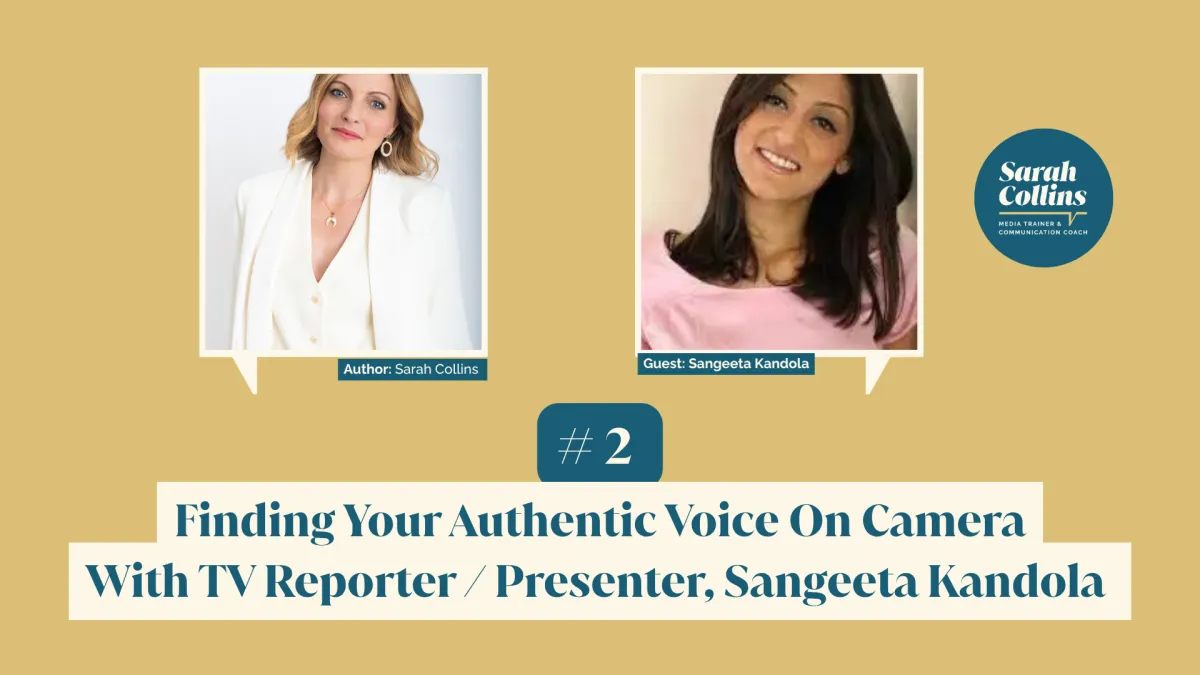
Finding Your Authentic Voice On Camera, with TV Reporter Presenter, Sangeeta Kandola
TV Reporter, Presenter, and Broadcast Journalist Sangeeta Kandola has been on our screens and radio airwaves for the last 20 years, working mainly for ITN and Channel 5 News, and more recently returning to radio at News UK, where she can be heard on Talk Radio, Virgin, and Talk Sport.
What makes this conversation particularly special is that Sangeeta has spent her entire career asking the questions - this was her first time being on the other side of the mic. What she shared was candid, generous, and full of the kind of insight you only get from someone who has truly lived it.
You described yourself in your notes as ‘just a girl from Essex.’ Can you share the moment when you realised your voice truly mattered?
At every stage of trying to become a broadcast journalist, I felt like most of the people around me had connections - a foot in the door already. I remember working at Rise on Channel 4, being the only one whose pick-up time of 3.20 in the morning meant the longest journey home, while the runners were living in Kensington or Richmond. I was just someone who went to a normal school and wanted to read the news and tell people stories.
I'm not sure there was one defining moment, but actually, maybe there was. When I got the call to join London Tonight, the show I had always loved and wanted to be part of, I think that was the moment I thought: I've done it. I've made it.
Tell me about your journey with your authentic voice on camera. Did you ever feel like you needed to put on a different voice?
Definitely. With my accent - I'm from Essex - so people comment on it most days. I had this preconception in my own head, especially when I started at ITV News and Sky News, that a newsreader had bobbed hair, sat very still, was very serious, and spoke the Queen's English. I was putting on that kind of broadcast telephone accent for probably four or five years without even realising it.
Recently, one of those TV news archive organisations sent me a clip of myself from 20 years ago on the ITV Morning News. I didn't recognise the person. The way I was reading, the way I was holding myself, it wasn't me at all. I was very posh. Very formal.
I think it was through the reporting that the shift happened - not deliberately, it just did. When you're engaging with people on a red carpet or doing a human interest story, you cannot help but be yourself. It's like going into the Big Brother house: everyone's on their best behaviour at first, but you can't keep that up. At some point you revert to yourself, and you're always better for it. The reporting was better as a result.
What do you think is the key to being yourself on camera?
It's very easy to say ‘just be authentic - but it is really difficult. When the lights go on and the camera rolls, you do go into a different persona. And getting comfortable with yourself on camera only comes with time and experience.
That took me years. Years and years. And even now I carry imposter syndrome - this feeling that I'm going to get found out, that I'm just faking everything. But somewhere along the line, you realise that you're actually doing your job, and you can actually do it. When I'm looking down the barrel of a camera now, I try to imagine I'm just talking to one of my friends. Be as simple as you can. Be as clear as you can. I speak fast in day-to-day life, so there's always a voice in my head saying slow down, let people digest this. But that's what works - bringing yourself to it, rather than performing.
You've been described as a ‘trusted voice in UK broadcasting.’ What does being a ‘trusted voice’ mean to you, particularly in this digital era?
It's more important now than ever. With AI, citizen journalism, and so much content appearing online, we're questioning everything in a way we simply didn't before. To work for ITV, Channel 5, News UK - it matters deeply to me as both a person and a journalist to make sure I'm not speculating, that I'm reporting facts, checking and verifying everything.
You want to be seen as someone who is trusted and honest. And I do feel like working for broadcasters who share those values means we bring that to the table.
I think the same applies to business owners. We've all become reliant on tools like ChatGPT for content, but the same rules apply - it's always important to double-check your facts and make sure that what you're saying is true. That's what builds credibility, whatever industry you're in.
Do you think an on-screen presence is something you're born with, or something that can be taught?
For me, it has taken a very long time. I've been in broadcasting for 20 years, and it's probably only as I passed my forties that I thought: do you know what, I don't care. I am just me. What you see is what you get.
What's interesting about younger generations is that they're probably more authentic at an earlier age than it's taken my generation to be. I see it with my own children - they're 13, 11 and 8, and they are super confident. I genuinely go to them for advice sometimes. They'll look at something I'm planning to post and say, mum, here's how someone else will see this, here's what you need to do instead. And that actually feeds my confidence too.
But my own journey has also been shaped by being a woman, and a woman of colour, entering an industry that was very male-dominated when I started. When I first came in, I was one of maybe one or two Asian people at the broadcasters I was working for. In some ways that felt like a positive, in others it was hard. The industry has changed, but it still has a long way to go.
Imposter syndrome comes up so much, particularly for women of our generation. Do you think it held you back from using your voice?
One hundred percent. When I look back, I think: God, I wish I'd had more confidence. I was at ITV, I was working for Sky News - and I was still thinking I was going to get found out. I turned down so many opportunities. People would offer me things and I'd make an excuse. My husband would hear about it later and say, you can do that, why didn't you go for it? And I'd say, no, I can't. I'm going to do a bad job. Better to leave them thinking I'm great than to prove otherwise.
Even this podcast was my first interview, really - because I've always avoided things like this. Being scared to be authentic. Scared to put myself on the line. Scared to just talk.
But since turning 40, things have shifted. I've said yes to far more. And what I'd say to anyone thinking about doing anything - it doesn't have to be broadcasting - is that even if you think you're going to fail, even if you do fail, that's part of the success. You have to fall to get up again. I wish I'd said yes to more things. That's why I'm very pushy with my own girls now - just do it, go and do it, why not?
When you're conducting an interview, what qualities are you looking for in a guest?
Just engagement. Listening to what's being asked and responding naturally - keeping the conversation going. Once you've got that connection, you'll always have a good interview. And if it's their subject, they're the expert. That's the greatest thing a guest can bring.
Reading from scripts is something I saw time and again as a producer. What's your experience of that?
I do feel for people who rely on scripts, because it really isn't easy to be interviewed. Even if it's your subject and your knowledge is deep, it's still a lot to hold at once - eye contact, composure, authenticity, being natural. Broadcast journalists have had training and years of experience. It's hard for someone who's never done it before to just arrive at that.
I'll be honest, going through perimenopause, I wouldn't be without notes. I have them there for lives, just in case my mind goes blank. But the thing about having notes is that your brain tends to tell you you need them, even when you don't. If you've got nothing there, you just go. You're not going to blank. Unless you've got perimenopause, maybe.
You come across as incredibly composed on screen. What strategies do you use when you're panicking inside?
Sometimes when I'm panicking, that's when I perform the best. In the early days, I'd be in a studio terrified, my leg shaking under the desk and nobody would know. That adrenaline can actually push you through.
But to compose myself, I'm a big believer in deep breathing. Whatever the stress, it's always: stop, just take a breath, it's going to be okay. And I'm a great believer in visualisation - imagining the end of the broadcast and thinking: that was fantastic, I've already done it, didn't I do well. It's mind over matter. Athletes do it - they envision the finish line. It's training your brain to play out the positive outcome rather than the negative one.
You've mentioned you get nervous before every single broadcast. Even now?
Every broadcast. I'm never complacent. I'll be working tonight and I'll be nervous before I go on, because you never know what's going to happen or how you're going to perform.
But what's changed over the years is how I respond to mistakes when they happen. In the early days, if I fluffed a line I'd beat myself up watching it back. Now I think: that was nothing. People stumble in everyday conversation. They say the wrong thing and correct themselves. Being a little easier on yourself matters.
I remember doing a red carpet live with Ray Winstone a couple of years ago and I fluffed a line - forgot the pronunciation of a word. I apologised to my boss afterwards and she said: no, it was lovely. I loved that. It just makes you so normal. And I thought - do you know what, that's actually really nice.
To close, can you fill in the blank: listeners should speak with...
….honesty and confidence in themselves. In television we'd always say: it's only telly, just be you. You can only be you. You're the best person at it. You're the expert.
Prefer Audio?
You can also listen to this episode on my podcast: She Speaks to Scale.
Need a confidence boost before appearing on camera?
Download my free 5 minute camera confidence audio here
How To Work With Me
I'm Sarah Collins - Media trainer, Communication Coach, and former Senior Television Producer for ITV & ITN. I work with ambitious founders and spokespeople in businesses to help them communicate with clarity, confidence, and composure in the moments that matter most. If you've got a podcast, interview, or speaking opportunity coming up and you want to feel truly ready for it, this is how we can work together:
Founders who want to become an expert voice in their field
Organisations who want their representatives to become credible spokespeople