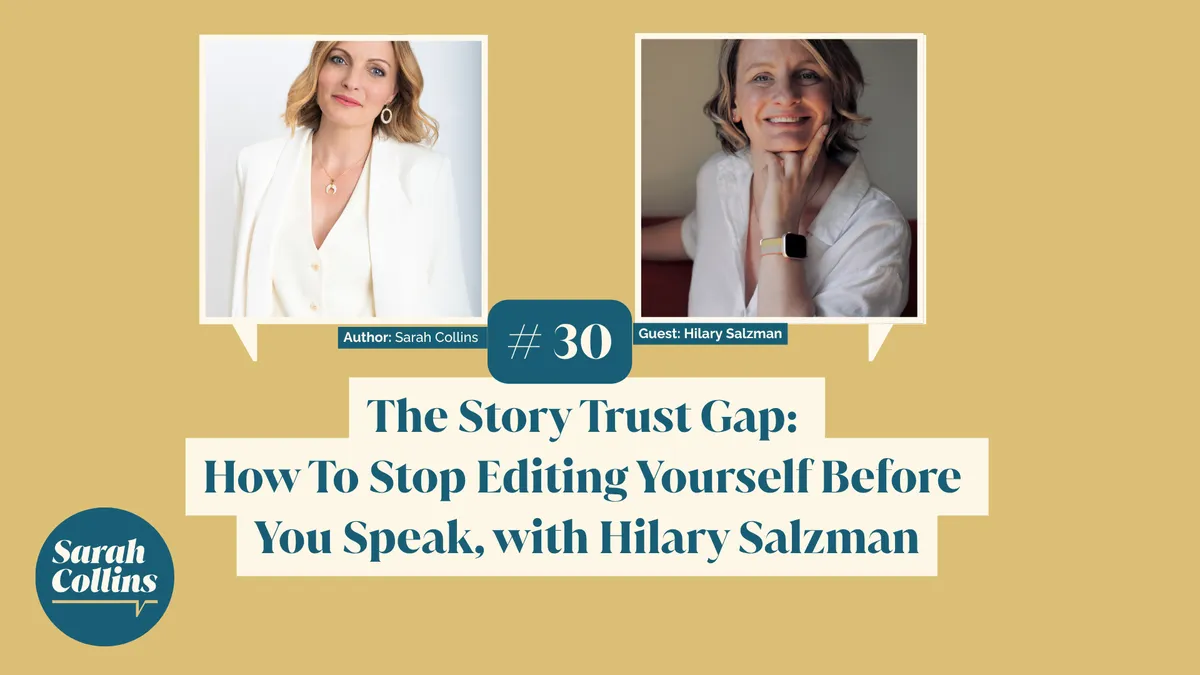
The Story Trust Gap: How to Stop Editing Yourself and Start Speaking Your Truth, with Hilary Salzman
My guest today is Hilary Salzman - Business Storytelling Consultant, Author of The Roar of Her Story (shortlisted for a Business Book Award in 2025), and Founder of the She Roars Club, an accountability community for women founders. Hilary spent 20 years in corporate marketing at major tech brands and her own agency before launching her storytelling consultancy. Hilary shows them how to use real experiences - even the messy bits - to build genuine connections, grow a successful business, and take up the space they truly deserve.
Can you share the moment when you realised your voice truly mattered?
It's a great question to get started with, and it's really made me think, because it's hard to pinpoint these things, isn't it? I think really it was when I started to get feedback from the women I work with. As you introduced me, I'm a storyteller, I work predominantly with women, and it was realising the value in my own voice, my own story, when somebody else said: my God, that was really helpful that you shared that.
One of the moments that really sticks out was actually not sharing anything to do with storytelling, not sharing anything to do with businessy type stuff, which I normally do. I was talking about my struggles with my mental health. I had panic attacks and I still do get panic attacks. I've had them since I was a late teenager. And somebody wrote and said: my God, it's really nice to hear someone talking so honestly about this. And I think it's then that you realise that the things we have to share really matter.
But interestingly, in that moment, my mum also got in touch with me and said, why on earth are you sharing that stuff? I said, what do you mean? She said, well, surely no one cares. That's really personal stuff, no one's interested.
So that was a real light bulb moment for me. And she did it in a nice way, which probably makes her sound like she's an awful woman. But it was maybe that generational thing of: why are you opening up? Why do people care? Why is anyone interested in what you have to say? And I think that's the crux of the problem, isn't it, really? But that's the moment for me, realising that my voice could help others.
I agree, I think it's a generational thing. We've been brought up by women who perhaps didn't feel like they had a voice, and we've been instilled to do the same and yet we're a generation who are finding our voice and bringing up children who are equally finding theirs right now. What are your thoughts on that?
I think it's fascinating. I've got a 17-year-old daughter and I can see the differences. If I look at how I was at her age and how I was using my voice, it's so different. With her and her friends, yes, they have a whole heap of other stuff they're dealing with - it's not easy being a 17-year-old for sure. But in terms of being able to share their emotions, being able to talk about how they feel, being able to share their dreams, to have an opinion - that's very different from when I was that age.
And I think it was because my mum, bless her - I love my mum to bits - but that generation, we don't talk about how we feel, we don't rock the boat. My granny used to say ‘children should be seen and not heard.’ And then it was women who should be seen and not heard. There's all of this stuff that we get lumbered with, and it's the same through the education system at school. I was told off for talking too much, and before you know it, Hilary talks too much translates in your head as: don't talk, it's bad, don't speak up.
I think generationally we're getting better. In terms of me really finding my voice, it hasn't really come out until I hit my forties. I'm forty-six now, and there is something about this midlife period where we're just like, right, I'm just going to go for it now. Which is a good thing, because it's teaching our children that it's okay. I've had to work hard to reverse some of the lessons I had from my own family and from education, to be able to speak up now. But it's all of those influences, isn't it? It's all of the external stuff that can impact how we show up.
This was the purpose behind this podcast: we are a generation of women who weren't taught how to use our voice to its full potential. I want to rewind and hear about your career before you started your business. I read that you were an introvert in an industry where there were really loud voices.
I'm still very much an introvert. I've learned that when I'm passionate about what I do, I come across as more out there, but I'm still essentially a very introverted person.
I come from a corporate background. I started off working in marketing for software companies, then worked my way up the ladder in IT and technology and telecoms. Businesses in that sector, are very male-oriented, very much about how fast you can get up that ladder, not caring about who you push down on the way up. It's about being able to speak up, and not necessarily add value - it's the people who can speak the loudest who get the promotions and get the leg up. And I found that really hard. I didn't feel like I had a place. I felt really uncomfortable within the corporate setting. I stayed there a long time, and I even set up an agency for six years in that space. It's that feeling of never quite fitting. I felt I had to show up in the same way everybody else was. If you could stand up and give an opinion, you'd move up. If you were quiet and introverted like I was, you were pushed to the wayside and you had to work extra, extra hard.
So I had a daughter, took a year out, and then I went freelance. Eventually I set up this agency with another woman, and we were really trying to do things differently. At the beginning I felt, right, this is my space, I can be more naturally me. As the business grew, though, and we took on another female director, the three of us, I very much found myself still performing. We were still in this industry and the worst thing I noticed is how everybody around me was moulding their voices to be more male, to fit in with our customers. It was a really bizarre place to be. I was thinking: this is still not me. I'm in meetings saying things that don't feel like me, putting on a brave face, being the director of this agency and selling hundreds of thousands of pounds' worth of marketing services into really big brands, and just feeling awful about it, still not feeling like I was being true to myself.
Eventually it made me ill and I had to make a choice. I stepped down from the board of that agency and said, right, this is it, I've got to get out of this space. And I think that was another big turning point - leaving the corporate world and going, right, I've got to do this by myself now. As soon as I started talking about this stuff in my new business and it resonated with people, that gave me the confidence that I had something to say.
It wasn't about finding my voice. I think I'd just stopped using my voice, and maybe I had never really got started. I certainly had a strong voice when I was a child - I was the youngest of three, so I had to shout very loudly to be heard. But very quickly that got knocked out of me.
What's amazing about what you've just said is that acknowledgement. You acknowledged that you weren't using your voice in the way you wanted to, and so many people push past that. You said before about women having to come across as professional - it sounds like that was your experience.
Yes, very much so. There is only so much of that I could do. Lots of people manage to push on through and they'll spend their whole careers, their whole life, in that box, and I thought, I can't do this anymore. I want to be able to speak. I've got opinions, I'm bright, I'm intelligent, I've got views of the world. I need to be able to express that in the way that feels right to me. And there's this constant pressure to show up as "professional.”
That idea that there are certain standards we have to follow really traps you. Some people fit really well into that world, and that's cool. But for people who don't feel they fit, trying to constantly show up, mould your voice, say the right thing, use the right language. I've been criticised because when I get quite excited, the pitch of my voice goes up and I get squeaky. People have been really mean about that, so I'm really conscious of having to lower my voice. It's ridiculous that we're having to do these things just to be seen as credible and professional. And again, getting into my forties, I thought, sod this. Why do I need to be doing this anymore? This is absolutely crazy that we have to do this.
I think it's a very brave thing that you've acknowledged it and then done something about it, because too many women just carry on on that treadmill.
They do, definitely. And I think that's what drives me to do what I do now as a business. Because of my experiences, and because I still don't quite know where that bravery came from - I think it was sheer: I can't do this anymore, there has to be a different way. Going through that process myself and then realising there's really big value in that whole transformation piece, and in helping other women. The majority of the women I speak to, work with and network with are in this space where they feel they're not brave enough.
I'm very cautious around the words ‘bravery’ and ‘confidence.’ I don't think it is actually that they're not brave enough, or not confident enough. They don't trust themselves enough to go and do these things, because of all those external influences. We blame ourselves: I'm not confident enough, I'm not brave enough, I'm not courageous enough to stand up and do that, or I haven't got the thoughts to do that. But it's all the pressures around us that wear us down.
I definitely got to the point where I just thought, I don't care anymore, I'm just going to do this stuff. Like I said, I was getting really ill and it was really impacting my mental health, and you get to the point where you have to do something different. And then thinking, right, okay, I can build a business from this, I can help other women. That's the thing that gets me excited. It's what gets me up every day. And I love it when people are just like, right, I'm showing up as me. I'm sure you're the same.
You can tell in the way that you're speaking how passionate you are. When did your love of storytelling first become apparent, do you think?
When I was tiny. This is something that has been in me since I was little. I loved to write. As small as I can remember, I was making little books - little paper books stapled together with my own rubbish drawings. Then Dad got a word processor, and I remember being really excited that I could go on it and write stories and have everything on my own floppy disc, showing my age.
I had a very strong imagination as a child. I was the youngest of three, with quite a big age gap, so I spent quite a lot of time by myself, and a lot of that was coming up with stories. So it's always been in me to write. Originally I wanted to be a journalist, and things didn't quite work out that way, as they never do.
When I was working in these big tech companies, I was doing something called Value Proposition Marketing, which is all about creating a story about the value of the product or service for the customer who's buying it. Back in the early 2000s this was quite revolutionary, because most tech companies were still talking about speeds of networks and how many times around the world their fibre cables went. It was the beginning for me of understanding a different way of communicating, where you're really thinking about what the person buying is going through.
From that, storytelling for business was the next step, because this stuff was still quite boring for me. I wanted to get creative, I wanted to get fun with this stuff, so I went on a few courses and started to understand the reasoning behind storytelling. I learned quite a lot about the science behind it. There's a humongous amount of neuroscience behind storytelling - storytelling is actually chemical responses in our brains. There are whole reasons why we are storytellers as humans - I could spend the whole of this podcast telling you about it, but I won't.
For me it was then that natural progression: I love to write, I understand the power of storytelling, I understand what it means from a business perspective, how it builds trust, how it helps people develop empathy. And I've got my own story here. So how do I bring that all together? That's how I ended up building a business as a business storyteller. For me it's all connected to getting that voice out there. We've got so many stories inside us, so much that we can share. If we learn the value of those stories and the techniques to tell them, using our voice becomes easier, because it's a human way of communicating. It's about helping people find a more natural way to use their voice, rather than some of the more serious marketing techniques. This is about tapping into what we've been doing since the beginning of time, really.
Storytelling is something I feel passionate about too. But I'm thinking about listeners who might be thinking: sharing my story feels very vulnerable, and I don't quite know how to be authentic and be myself. We're of that generation - perhaps we've had children, we've almost lost our identity a bit, we've forgotten who we are. So what are our stories? What would you say to those women?
First, I think they're really common questions and concerns. Most of the people I work with will ask the same thing.
Regarding the vulnerability piece - vulnerability became a real big trend a couple of years ago, and everyone was saying you've got to be more vulnerable on social media, telling your story, being more authentic. It doesn't mean sharing everything. I think there's this misconception, and that would feel really scary. I am a storyteller who is pretty open about my life, but really it's probably still only about 10% of the reality of my life that I share in public. So it's about setting your own boundaries.
And this is the big shift for me. Rather than editing yourself because you feel it's the right thing to do - I can only speak about this, because otherwise it would be unprofessional - if that is the kind of thing keeping you from sharing these stories, I would argue that mindset can shift to: okay, I'll take that whole piece out. What is it that I really, really want to say? And what do I personally feel comfortable sharing? Not what is acceptable in the wider world - what do I feel comfortable sharing?
The other side of that is thinking about who you're sharing to. In a business perspective we're often thinking about our customer, or if you're building a community, our community. So: I want to share this stuff - which bits of it are going to be relevant to my audience? Which bits are going to be relatable? Which bits are going to be interesting? We all see it on Instagram, this feeling of trauma dumping, where people just share everything. The whole point of storytelling is making connections with people. So I always say it's like holding up a mirror to your audience. In the bits you're sharing, you want the people you're trying to connect to to be able to see themselves in that story.
That's why I know with a lot of confidence that if I speak about my mental health issues, if I talk about perimenopause, if I talk about struggles bringing up children and running a business, it's relevant content, because that's exactly the life stage my audience are in right now. If I started talking about something completely different, it wouldn't be relevant. So you've got to set those boundaries. And being authentic - again, we get to say what our authentic self is. Nobody else gets to set that standard for us. There isn't a rule book that says you've got to be like this. Some people will show up and be loud and brash. Some people will be really quiet. There's value in all of that.
I would say to people listening, it's about taking the time to really connect with who you are inside. This is the path I take with the people I work with - going right back to the beginning, looking at who you were before children, who you were as a child, the moments in your life that have taken you to where you are now. And then: if you were to take away all of that noise, all of that stuff we tell ourselves, what is the thing you would really like to share? What's the opinion? What's the experience? Let that be the starting point, and then build and edit from that perspective, rather than starting at the other end and trying to build in a bit of authenticity. Go from the really true moment and get it to a point where you feel comfortable sharing it, rather than the other way around.
I've not really shared this before, but when you were speaking, something came up for me. The whole of last year, I really wanted to share that I think we're women of a certain generation who weren't taught the skills we needed to thrive in business today. Podcasts weren't around, networking for women wasn't around, social media wasn't around. And I sat on that for so long and didn't say anything. Then being able to say it, through starting my podcast, through social media posts and my emails, felt really liberating. And I think we forget that there are benefits to sharing these stories.
Absolutely there is. Just out of interest, have you been able to reconcile what was holding you back?
It was judgment. It was purely judgment. I was worried about what other people were going to say. I had to work quite a lot on myself to get past that.
Again, all the women I work with, in one way or another, have that fear of judgment. I totally understand it because I had the same and I still do to an extent. But it's so infuriating as well, because so often the people we're so fearful of being judged by are people who would never impact us as a business. They're never going to buy from us. It used to be my family. Someone said to me once, I haven't shared this stuff because I'm worried about the other mums at the school gate. Why do we care so much about this stuff? But we do.
I remember when I left corporate, I had a very big network there, because I'd been in it for several decades. I started up my Instagram account and I was doing behind the scenes - this is my office - and one of the corporate guys I'd worked with got in touch and said, I see you're trying to be an Instagram influencer now. This was maybe within the first couple of weeks of running my business. And I didn't share anything else for a couple of months, because it really got to me. This is the problem. But I thought, hang on, I'm not trying to sell to this guy anymore. He's not the person I'm trying to connect with. I'm trying to connect with other women in similar situations, working from home.
So it's that mindset thing: who are we most scared of? Do they matter in our lives? Are they ever going to buy from us? Are they ever going to recommend us? And just trying to build up that muscle to be able to share. And like you said, it is really liberating. When you do it and you think, this feels good, it's a weight off the shoulder. Remember that. The next time you want to share something you've been sat with, you'll remember how good it felt. Keep a record of the comments you get from other people saying so pleased you shared that, because this is the stuff that will help us overcome that fear of judgment. But it's really real, and these are things we have to work through on a daily basis, which really annoys me because I don't think men think that way so much.
It goes back to what you were saying at the very start about resonating with people. You talk about the Story Trust Gap. Can you tell us a little bit more about that?
I think I've always been aware of this, or certainly over the last few years I've been more and more aware of it, but I decided this year to give it a name.
It's the idea that when it comes to speaking up, sharing our voice, telling our story, the barrier isn't us. It's not a confidence gap, it's not a confidence deficit - it's that idea that we're broken, we have to fix ourselves, we haven't got enough confidence. The Story Trust Gap is actually what it says: it's us not being able to trust our stories enough. It's the gap that exists between what we truly want to say and what we think we can say without cost.
And this idea of cost is really scary. It might be financial cost, it could be risk. We say: right, I've got this point of view I want to get across - like your point of view, completely valid, really good, something you wanted to share, really helpful to other people, really relatable. And then we're like, hang on a minute. If I do that, what is that going to cost me? Are people going to judge me? Are people going to attack me for it? Am I going to lose out on that promotion? Are clients not going to like me because of it? It can get even more serious if you think of certain demographics speaking up. If you think back to the Me Too movement, people were being cancelled, people lost their whole careers because they spoke up. That's an extreme version of it, but that's what I'm talking about.
Because we've got that cost, and we've got this story we want to tell, we end up in a situation where we soften and edit our words before they even get out there. The version of ourselves that shows up is this hybrid, safe version that no one's going to fire - but equally, you're not going to be setting the world on fire, because you're just in this middle ground. And in business, that middle ground is not necessarily the best place to be. In life it isn't either.
So this gap between what we want to say and what we think we can say without that personal risk to us - for me, naming it is the first part of the work. It helps us recognise that it's not a failure on our part. It's not that we're not confident enough as women. We don't need to go on a confidence course. We don't need to go on a presentation course. We need to trust what our experience is, we need to trust what we really believe in, and we need to work on finding a way to bring that true version out.
There are parallels with the work I do. When I'm teaching people to appear on camera, there's a real difference between just appearing on camera and saying what you need to say, and appearing on camera with belief and trust in what you're saying. It comes across very differently. What's one thing people could do to instil that trust?
The starting point is noticing when you're about to edit. If you're going into a meeting, writing a post, doing a pitch, whatever it might be, think: what am I leaving out that doesn't feel safe, and why doesn't it feel safe? It's having that ability to pause for a minute and say, right, is this really it? Have I already subconsciously edited something out? And being able to name the thing you're missing out, and work on it. It doesn't mean you have to do everything all in one go.
Instagram is a good place to try this, or LinkedIn. Put out a story that's a little bit less edited and see the response, and use that as evidence: right, the world didn't collapse because I spoke my mind a bit here. Let's push it a little further next time. It's just taking that moment to check whether you're editing something, because we do it subconsciously. It's so ingrained in us, because of everything we've discussed today, to do that safety check before we've even written anything. It's in our brain that we have to soften these things. So take that moment to double-check, and then try stuff. What is the worst thing that's going to happen? You might get trolled, and that's not very nice - I've had that. But there are safer places to try it, aren't there?
Networking, I think, is a really good place to test your voice. I've got lovely all-female networking groups in Bath, and they're the safest, loveliest places where you can show up and be your true self. So it's sometimes finding those spaces, testing it, practising, and getting comfortable within them, to then be able to go, okay, right, I can take it out. And there's nothing more empowering than doing it and a load of other women going, yeah, you've got this, come on. We need to recognise when people are sharing their truth and not attack them for it, and just support people in doing this.
You're also the author of The Roar of Her Story. Before we wrap up, what does it mean to roar?
I was asked this a little while ago, actually. For me, it's almost the wrong word as an introvert - I don't roar, but that's the point. It's about finding our own way of roaring - some people can do it in the most loud, bright, wonderful way, because that's who they are. For other people it's the quiet, understated way of talking. It's about finding your way.
Roaring is doing it in a way that makes you feel good, that doesn't make you feel trapped, that doesn't make you feel like you're showing up as someone you're not, that doesn't lead to all of these self-doubts. It's finding your truth, finding your way to show up, being your own self and doing it. It's not for me to tell you how you should roar - it's for you to decide what your roar sounds like.
The more we do that, the more we can show up in our own way, and the more we're going to change things for the future, I think.
I always ask my guests: if you could share a word or a phrase that fills in the blank - listeners should speak with...what would that be and why?
For me it's speaking with honesty and speaking with truth. This is about trusting yourself. I think we need to empower ourselves, and empower our friends, to trust who we are. We are brilliant, brilliant people, all of our experiences are valid and worthwhile, and add value to the right people. So let's just speak with that honesty and trust our truth.
Hilary can be found on Instagram at @hilarysalzmanstories and on LinkedIn as Hilary Salzman. Her Substack, Speaking of Stories, is a brilliant place to go if you love long-form writing. And her book, The Roar of Her Story, is available at hilarysalzman.com.
Prefer Audio?
You can also listen to this episode on my podcast: She Speaks to Scale.
Want to find out which Speaker Identity you are?
Take the quiz here
When you’re ready, here’s how I can support you:
I'm Sarah Collins - Speaking Coach, Media Trainer and former Senior Television Producer for ITV & ITN.
I provide 1:1 coaching and group coaching for women in business to move past self doubt and learn to speak confidently on social media, podcasts, panels and stages, so they can step into those speaking opportunities that once felt out of reach, with ease.
Let's discuss your needs
I also provide media training for spokespeople within organisations, communication skills workshops and DISC profiling.
Voice people listen to, trust and remember