
The Rise of Yapping: Why Now is the Time to Start Talking to Camera
With all the hype online about the Yap Challenge, I felt compelled to address it - because it sits right at the heart of what I do.
I avoided talking to camera for the best part of 20 years - my entire career in television. There were opportunities: filming a message for a colleague who was leaving, being part of something we were making. I said no to all of them. Looking back, I know it was because I wasn't fully comfortable with my own thoughts and opinions - I was the person behind the camera, not in front of it.
I'm so grateful now that I've done the inner work - because I can express my insights and thoughts more freely, without the fear of judgment and without the fear of failure. And that's exactly what this episode is about.
The History of 'Yapping' - It's Not What You Think
Just in case you've been hiding under a rock for the last week or so: the Yap Challenge is a viral challenge created by content creator Jessie Jean in the US. It's essentially about learning to talk on camera - something I've been teaching my clients for years, just without the catchy name.
But the term itself has a fascinating history.
Yapping has been around since the 1600s. In its original form, yap was used to describe the sharp, repetitive bark of small dogs. It then evolved into a term for someone talking nonstop about unimportant things - whiny, irritating, too much. For a long time, being called a yapper was not a compliment.
Then Gen Z got hold of it.
TikTok creators began using yapping to describe something entirely different - filming themselves explaining something, ranting about a topic they care about, discussing their opinions in a raw, unscripted, straight-to-camera way. It became cool to yap. Content creators started proudly claiming they loved to yap. The term migrated to Instagram, where it became a quirky personality trait - and then Jessie Jean's Yap Challenge took it fully viral.
The Yap Challenge: What the Numbers Tell Us
Jessie Jean didn't have overnight success. She spent six months building a deeply engaged audience through consistent yapping to camera - showing vulnerability, telling stories, showing up authentically and repeatedly.
At the time of recording, she has 425,000 followers on Instagram. When she launched her six-week Yap Challenge, over 4,000 people signed up in just 13 days - generating a reported $1.2 million in revenue.
What does that tell us? Not only that Jessie is exceptional at building and nurturing an audience, but that the ability to talk confidently to camera is a skill that huge numbers of people are actively looking to improve. The demand was already there. She just gave it a name and a framework.
Why Yapping to Camera Will Never Go Away
Business is built on trust and connection and one of the quickest ways to build both with your audience is to show them your face and let them hear your voice. In the digital age, being the face and voice of your brand isn't optional - it's essential.
AI content is everywhere. Which is precisely why it's become so refreshing to go online and find a real person sharing their personal insights, opinions, and perspective. That's how you stand out now.
Talking confidently to camera is a skill that can be learnt. It starts with self-awareness - knowing who you are and what you want to say. Then it's about using your tone, your energy, and your presence to engage and connect with the person watching. And here's the most important thing: your stories, your insights, your opinions, and your perspectives cannot be written by AI. As audiences become increasingly aware of AI-generated content, your authentic voice on camera becomes your greatest differentiator.
The people already showing up on camera don't have it all figured out. They still experience imposter syndrome. They still stumble over their words sometimes. But they show up imperfectly and consistently and that consistency is what builds an audience.
So stop waiting for the right moment. The perfect conditions don't exist. All you truly need is:
A decision that you are ready
The belief that no one is judging you as harshly as you're judging yourself
Something to say
Your audience wants to hear from you about what you know, what you think, what you've experienced, and what you want them to take away. They want to learn, be inspired, or be educated. And the only thing standing between you and that is pressing record.

Three Tips to Help You Start Yapping to Camera
1. Find the right environment
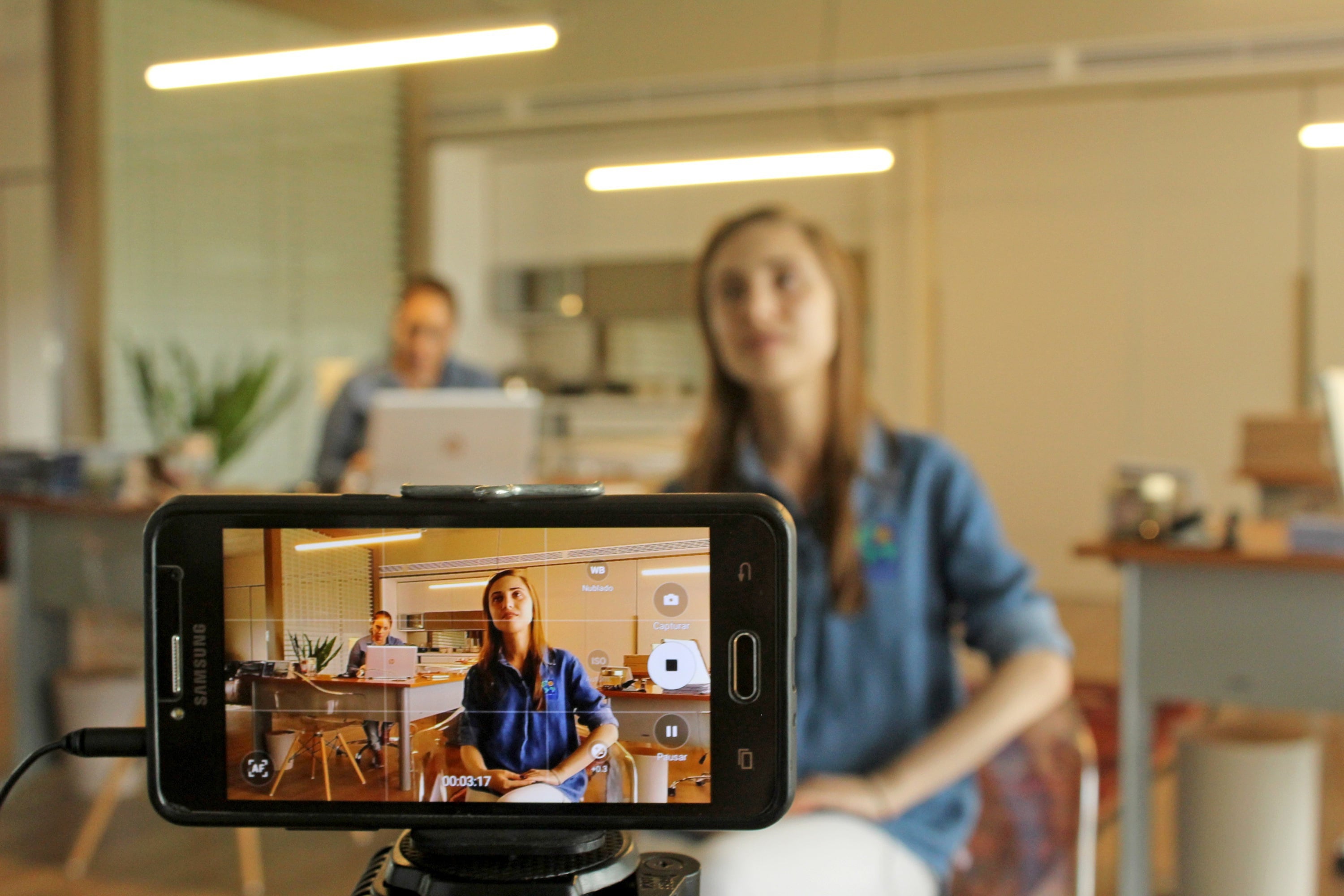
The right environment can be the difference between pressing record and putting it off for another day. And I promise, you don't need a professional setup.
You just need a space where you feel comfortable. Somewhere that feels like you, where the lighting is working in your favour, and where you're unlikely to be interrupted mid-flow. You've probably seen people filming in their cars, in a corner of their living room, on the school run. It just needs to be a space where getting your camera out is quick and easy - somewhere that removes the friction between the idea and the recording.
Natural light is your friend. Position yourself facing a window rather than with it behind you, and you'll look instantly more polished without spending a penny. Your background matters too - a tidy corner, a bookshelf, a clean wall. Something that reflects you and your brand rather than distracting from what you're saying.
And don't overlook sound - it's the thing most people forget, and the first thing that makes someone switch off. A room with soft furnishings absorbs echo far better than a hard-floored, high-ceilinged space. Close the windows, silence your phone, put the dog out, and let the people around you know you're recording. You don't need a fancy microphone - our phones are extraordinary these days. But if you did want to invest in anything, a ring light and a small clip-on microphone from Amazon is genuinely all you need.
Get your environment right, and you remove the excuses. Remove the excuses, and you're far more likely to press record.
2. Know how you want to start and end
You have just a few seconds to capture someone's attention before they scroll on, so your opening line matters enormously.
I'd recommend leading with a question, a bold statement, or a story - something that instantly creates a connection or sparks curiosity. What you don't want to do is open with "how are you?" - that takes up far too much precious time. Or "what I wanted to talk to you about today..." which, I'll admit, I'm guilty of sometimes. Both waste the seconds you simply don't have.
Equally important is knowing how you want to end. What do you want your audience to do next? Every time you speak to camera, you should have a call to action - one clear, specific next step. That might be directing people to your lead magnet (a freebie they sign up to with their email address), a sales page if you're promoting something, or something simpler - your podcast, your blog, your website or your book. Whatever it is, be specific. Tell them exactly where to go and make it as easy as possible for them to get there. Everyone's time is limited, so respect that.
3. Reframe how you feel about it
This is the most important tip of all - because all the practical advice in the world won't help if your mindset is working against you before you've even pressed record.
So many people sit down to film and immediately spiral. How do I look? What will people think? What if I stumble over my words? And before they've said a single thing, they've already talked themselves out of it.
I know, because that was me.
Here's the reframe I want you to try: instead of asking how do I look? - ask how do I want my audience to feel? Shift the focus from yourself to the person watching. When you're thinking about what they need, what will help them, what you want them to take away - there's simply no room for self-consciousness. You're too busy being useful.
Yapping to camera is a skill. And like every skill, it gets easier the more you do it. The first time will feel uncomfortable - mine certainly did. But the more you show up, the more natural it becomes.
Your Audience Is Waiting
The clients I've worked with who have built their on-camera confidence have gone on to run their own retreats, speak on stages, appear in interviews, and even speak in parliament. Once you have these skills, the opportunities really are endless.
So start before you feel ready, press record before the moment feels perfect. And remember - done is always better than perfect when it comes to showing up on camera.
Your audience is waiting, now all you have to do is press record.
Prefer Audio?
You can also listen to this episode on my podcast: She Speaks to Scale.
Need a confidence boost before appearing on camera?
Download my free 5 minute camera confidence audio here
When you're ready, here's how I can support you:
I'm Sarah Collins - Media trainer, Communication Coach, and former Senior Television Producer for ITV & ITN. I work with ambitious founders and spokespeople in businesses to help them communicate with clarity, confidence, and composure in the moments that matter most. If you've got a podcast, interview, or speaking opportunity coming up and you want to feel truly ready for it, this is how we can work together:
Founders who want to become an expert voice in their field
Organisations who want their representatives to become credible spokespeople
Photos by: Image by Fernando Aguirre Guzmán Pixabay, Image by Pexels from Pixabay & Photo by Vitaly Gariev on Unsplash