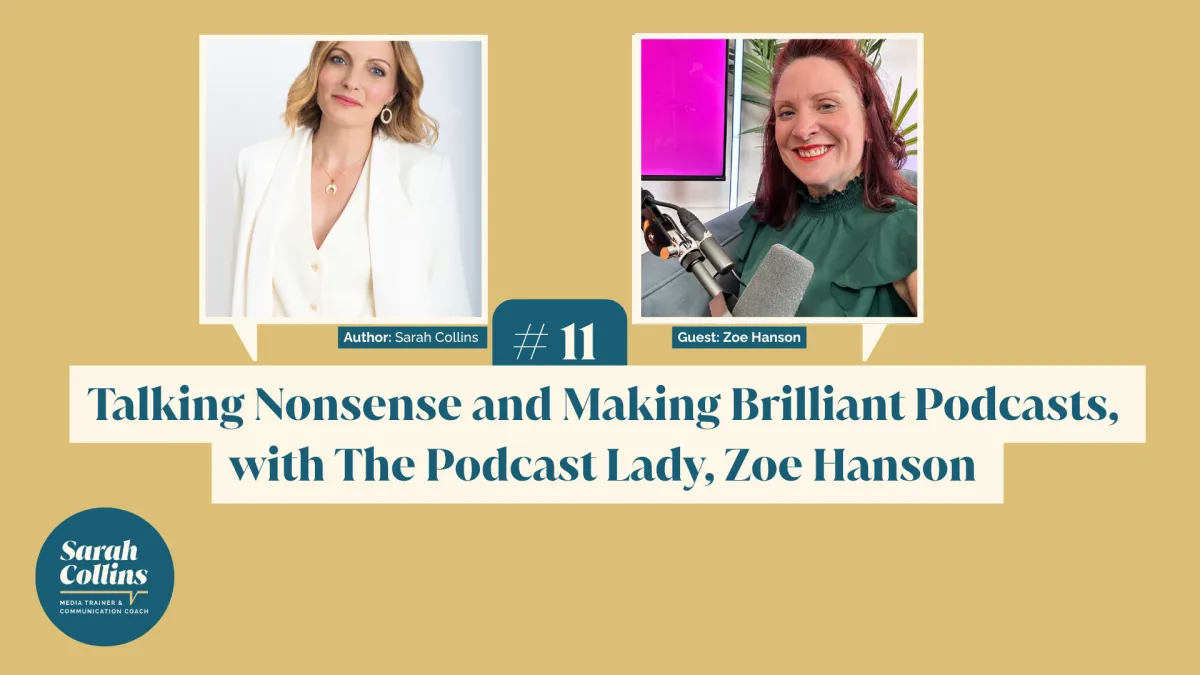
Talking Nonsense and Making Brilliant Podcasts, with The Podcast Lady, Zoe Hanson
Zoe Hanson is the Founder of The Podcast Lady, who after 20 years hosting breakfast shows on Capital and Heart Radio, now helps businesses make brilliant podcasts.
Can you share the moment when you realised your voice truly mattered?
I'm not really sure that it does - I describe what I do as talking nonsense! But my voice matters most when I'm talking to other people about their stories. It's my voice amplifying other people's stories, really.
For years it was on the radio - larking about, having fun. But now it's about telling people's stories, giving them a platform to talk about what they do and why they do it. When you share someone's story, people buy in, people connect, people focus in and it creates a bigger platform for that person.
The first time I realised my voice might make a difference was actually at the end of senior school, when I received my Head of Year's Award for loudest contribution to discussion. I'm making a living out of it now, so that worked out fine.
Tell us a bit more about your journey.
I went to do performing arts at college, mainly to waste time before I became a police officer. I quite enjoyed it, so off I went to Butlin's for about seven years as a Redcoat and I absolutely adored it.
At Butlin's, you have a captive audience. People have come there to be entertained, to laugh, to have a wonderful time. It was a brilliant apprenticeship for building connections, learning stagecraft, and learning how to engage an audience. Six shows a day on stage. The rest of the time - if you were in your uniform, you were connecting with people, making friends, finding common ground.
I later toured with an acting company and realised fairly quickly that I wasn't a very good actor - I was much better off just being myself. While I was working in London, I ended up doing interviews at a radio studio at the Ideal Home Exhibition, and the producer said afterwards: you're quite good at this. Six weeks later I was on a breakfast show in the Mecca of entertainment that is Weston-super-Mare, with 9,000 listeners. My next station had something like 700,000 listeners. I went from GWR in Bristol to Red Dragon in Cardiff, then to Capital Radio in London on the breakfast show with Johnny Vaughan, and then down to the South Coast for Power FM and Heart.
How did you move from radio into podcasting?
After 20 years of early mornings, Heart decided to go national. We always knew it was coming, but it was still heartbreaking and with a seven-year-old daughter at the time, there was no way I could move to a drive-time show. So I set up a podcast instead.
If Heart was going national, we'd go local. That was the thinking behind The So So Show - Southampton's podcast - which is still going strong seven years on. It's a positive beacon for the city: brilliant businesses, amazing events, wonderful people. We really shine a light on everything that happens here.
A couple of months in, businesses started approaching us and saying: we want to make our own podcast, can you help? And The Podcast Lady was born.
I see myself as the chauffeur. I know the stories, I know the bullet points, I'll get you there - and it all looks like a completely natural conversation.
What do you truly love about podcasting?
I love being able to help people share their story and connect with their audience. When the penny drops for a client - when they realise that by sharing their thoughts and feelings on a podcast, someone on a dog walk somewhere taps into it, connects with them, and then comes to them for their services - that's it. That's the whole thing.
People buy people, and they buy into story. Nobody is listening to a podcast where someone is towing the company line and thinking: yes, I really like these people. But when you speak naturally, in your own voice, to your actual audience, it flies. We made a podcast for an accountancy firm targeting groundworkers. When we made something that truly spoke to them - should I be a sole trader or a limited company? - it flew. People came for that accountant's services because they said: you speak my language. I can talk to you.
You've said there's only ever one listener. Can you explain that?
You're talking straight into somebody's brain. And the best broadcasters have always known this - I believe Terry Wogan said it too. There's only ever one listener. You talk directly to them and you have a conversation without them being there.
A barrister came to me once who said: I don't really like networking, can I make a podcast instead? She has since been held up by the Law Society as required listening for anyone studying law. She's just very candid, very authentic. It amplifies her personality without her having to stand in front of anyone. And people engage with it completely.
What are your top tips for someone creating their own podcast?
First, identify your audience and don't say it's everyone, because it isn't. Drill down. Who are they, where do they live, who are their friends, have they got a dog? One of my favourite questions is: what do they do on a Sunday morning? It really builds a picture of who you're talking to, and once you have that, everything else follows - what you want them to hear, and what you want them to do afterwards.
Then cut the faff. Once you're talking to your audience, if something isn't relevant, cut it. The conversation that happens in too many podcasts - hello, how are you, I'm fine, how are you, I'm fine too - we don't need it. We know you're fine because you're there.
And gift your audience something. If you want people to come to you for your services, give them something of value in every episode. Solve a problem. Share an insight. Give them a reason to come back.
And for someone guesting on a podcast - what makes a great guest?
Know your story so that you can tell it authentically. Before you go on, ask the host: what do you want from me? What are you expecting? Just that conversation will settle your nerves, because you'll realise they just want to chat with you about something you already know inside out.
A lot of people ask to be sent the questions in advance because they're worried they won't know what to say. But it's your subject. You know the answers. The thing that's making you nervous is the fact that it's being recorded - and that's completely understandable. But preparation isn't about memorising answers. It's about knowing what story you want to tell. Clarity before you sit down, and then just have the conversation.
You mentioned authenticity as the key to everything. Tell us more about that.
It's the authentic people, the passionate people, the vulnerable people that we buy into and cheerlead for. On social media, it's not the person who runs fast that captures our attention - it's the person who is authentically starting out, talking about it hurting, talking about the rain and the trainers and the ballot place for the marathon. Those are the ones we follow.
And vulnerability builds confidence, which I don't think people realise. Sharing something you found hard isn't just an authentic piece - it actually builds your own confidence in doing it. Every time you speak up about something real, something personal, you grow a little. The discomfort at the start is temporary. The confidence that follows isn't.
What's one myth you'd love to dispel about what you do?
That you can buy a microphone, talk into it, and that makes a great podcast.
People think their conversations are entertaining, and they probably are, down the pub. But you're not talking to your mates. You have to remember who you're actually talking to.
A great podcast is split into equal thirds. The first is preparation and planning - your audience, your roadmap for the series, curating your content. The second is the making: not just sitting down and having a chat, but all the thought and preparation that shapes the conversation. The third is editing and production. And then - the piece most people miss - the marketing. Nobody knows you're there until you're shouting about it. Clips on social media, showing up consistently, and actively bringing your audience in.
There's also the transcription piece, which most podcasters overlook entirely. Your podcast transcript can be used for SEO and GEO - it becomes a blog that gifts the same information to people who'd rather read than listen. And evergreen episodes: don't put something out and forget about it. Your audience grows, new people find you, and there's no reason not to republish episodes when they're most relevant. Know your audience, know when they need the information, and serve it to them at the right time.
To close - can you fill in the blank: listeners should speak with...
Authority and authenticity. Authority means you know what you want to say. People can't ignore you when you're confident. And authenticity is what makes people like you, connect with you, trust you. It's the thing that makes someone say: you're like me. Brilliant, we'll get on then. You need both - the conviction to say it, and the realness that makes people care.
Zoe can be found at The Podcast Lady website, and her new midlife podcast is coming very soon - watch out for it. You can also find The So So Show, Southampton's podcast, on all major platforms.
Prefer Audio?
You can also listen to this episode on my podcast: She Speaks to Scale.
Need a confidence boost before appearing on camera?
Download my free 5 minute camera confidence audio here
Want support with this?
I'm Sarah Collins - Media trainer, Communication Coach, and former Senior Television Producer for ITV & ITN. I work with ambitious founders and spokespeople in businesses to help them communicate with clarity, confidence, and composure in the moments that matter most. If you've got a podcast, interview, or speaking opportunity coming up and you want to feel truly ready for it, this is how we can work together:
Founders who want to become an expert voice in their field
Organisations who want their representatives to become credible spokespeople